1Get ready
Alerting
Thalamus · deep
The plus sign before each row puts your brain on alert. Warning cues speed up responses.
The game mixes three kinds of row. Play a round and your own average time fills in below.
All arrows agree. The fastest kind of row.
Neighbours point the other way. You have to block them out.
Dashes carry no direction. A baseline for comparison.
You can't focus on one arrow alone, your attention spills onto whatever sits nearby. Push the neighbours further away and the interference fades. Drag the slider to see it.
Tracking the car ahead while brake lights flash in the lanes on either side.
Keeping your eyes on one line while neighbouring lines tug for attention.
Finding the one notification that matters in a crowded dashboard or inbox.
Following the ball carrier while defenders move in your peripheral vision.
Move up a rung when you hit 90% accuracy with a flanker effect under 60 ms.
Extra space between arrows. Learn the rule without much pull from the neighbours.
The classic tight layout used in research.
Shorter pauses between rows. Less time to reset your focus.
Four in five rows conflict. Your brain can’t rely on the neighbours at all.
Psychologist Michael Posner described attention as three networks working together. A flanker trial uses all three in under a second.
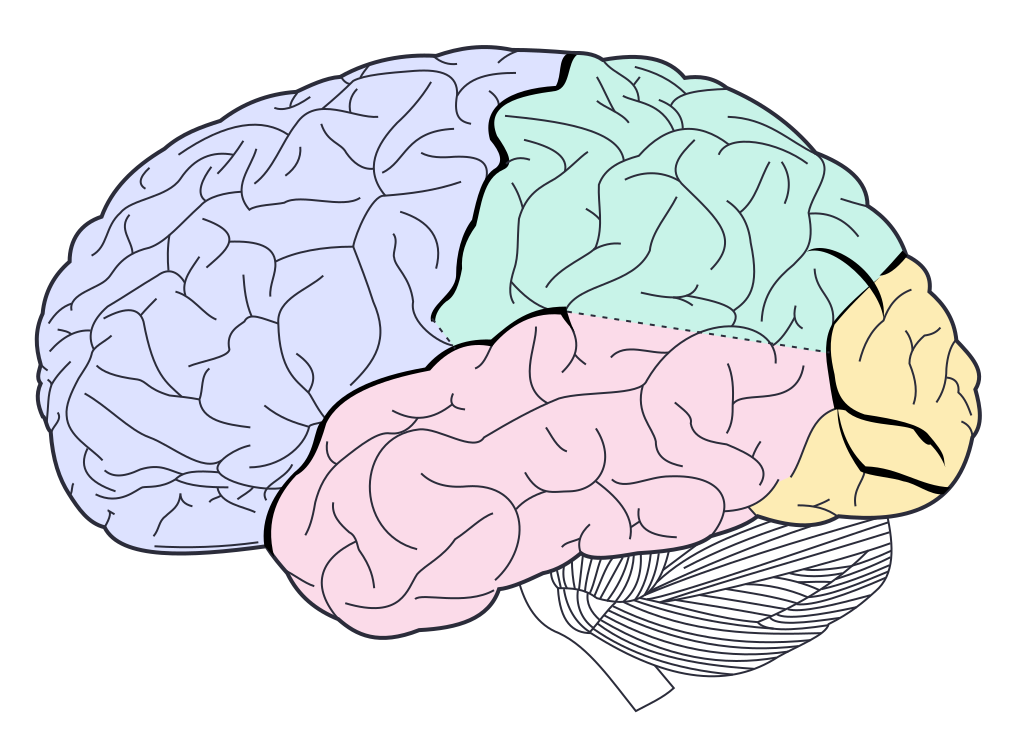
The plus sign before each row puts your brain on alert. Warning cues speed up responses.
Moves the spotlight to the centre of the row, the beam you saw in the slider above.
Settles the clash when neighbours disagree with the middle arrow. This network produces your flanker effect.
Barbara and Charles Eriksen asked people to respond to a centre letter while ignoring the letters beside it. Neighbours that called for a different response slowed everyone down, even when people knew exactly where to look. Arrows came later and are now the standard.
Respond to the middle arrow and ignore the ones beside it. When the neighbours point the other way you slow down; this game measures and trains how well you filter them out.
Name the ink colour of a word that spells a different colour.
Tap fast for targets, freeze when a lure appears.
Sort by colour, then by shape, the rule keeps changing.
Find the one odd item in a crowded grid as fast as you can.