What happens in the split second of a switch
Changing rules isn't instant. Your brain runs through three quick steps, and the old rule lingers while it does.
Drop the old rule
Let go of “odd or even”. It doesn’t fully vanish: it can still pull you toward the wrong key.
Load the new rule
Bring “higher or lower” into focus and remap what each key means.
Answer
Only now can you judge the number. All of this adds up to your switch cost.
Multitasking is really fast switching
“I’m doing two things at once.”
You’re flipping between them, paying a small reset cost each time.
“Checking email takes a second.”
Getting back into the first task takes longer than the check itself.
“I’m faster when I juggle.”
People usually finish two tasks sooner one after the other than interleaved.
“Practice makes switching free.”
Practice shrinks the cost, but it rarely reaches zero.
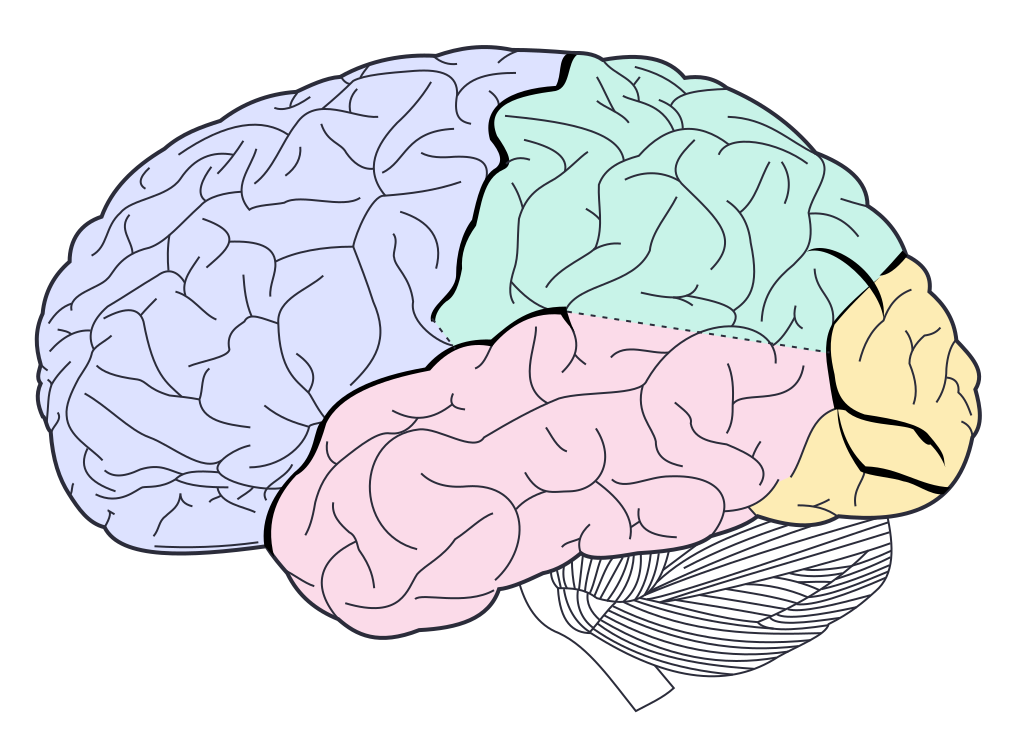
A front-to-back control loop
Prefrontal cortex holds the rule
Keeps the current goal, odd/even or high/low, active, and swaps it when the cue changes.
Parietal cortex re-maps the response
Links the same two keys to new meanings, so F now means “lower” instead of “odd”.
Pencil-and-paper switching
Arthur Jersild had people alternate between adding and subtracting on lists of numbers, and found that switching slowed them down.
The modern version
Robert Rogers and Stephen Monsell showed that a switch cost remains even with time to prepare, some reset only happens once the new item appears.
The cost of changing tasks
Sort by one rule, then switch to another. Every switch costs a little time, and this game measures and shrinks that cost.
Moments that use the same skill
More attention games
All 40 games →Name the ink, not the word.
Answer the middle arrow.
Tap green, hold for red.
Find the odd one fast.