Name the ink colour, not the word. Your brain will fight you on every one.
Difficultytrials & time limit
0/24✓ 0✗ 0
RED
–
accuracy
– ms
interference cost
Press the button (or R, B, G, Y) matching the ink colour. 24 words.
YOUR RESULTS, DECODED
The number that matters is the gap
Raw speed says little. The interference cost (how much slower you are when word and ink clash) shows how well you block out the automatic urge to read. Smaller is better.
REDMatch– ms
REDClash– ms
Play a round to see your interference cost– ms
Why the word always wins the race
You've read words millions of times, so reading has become automatic. Naming colours hasn't. Both signals race toward your answer, and reading gets there first.
Reading
automatic · fast
“RED”
Colour naming
effortful · slower
“blue”
When the two answers disagree, your brain has to stop the fast one and wait for the slow one. That braking is the extra time you see in your results.
Do this, not that
Blur your focus slightly
Look at the middle of the word as a colour patch. A softer focus makes the letters harder to read.
Stare hard at the letters
Sharp focus on the word makes reading even more automatic.
Say the colour in your head
Silently name the ink, “blue”, before you press. It gives colour naming a head start.
Read the word first
Once you’ve read it, you have to override it. That costs time.
Keep a steady rhythm
Aim for an even pace. Accuracy first, speed will follow as you practise.
Rush every answer
Rushing lets the fast reading signal win more often.
Rest your fingers on the keys
Use R, B, G and Y on the keyboard so the response is ready before you decide.
Hunt for the button
Searching for where to click adds time unrelated to your focus.
Practise little and often
A few short rounds a day improves interference control more than one long session.
Grind through when tired
Fatigue makes the automatic reading urge harder to resist.
Stroop is a family, not one test
Any time two features of the same thing point to different answers, you get a Stroop effect.
83
Number Stroop
Which number is bigger in value? The larger print pulls you toward the wrong one.
LEFT
Spatial Stroop
Say where the word sits, not what it says. Position and meaning clash.
FEAR
Emotional Stroop
Emotional words slow colour naming, used in research on anxiety and attention.
ʎɐʍ
Reverse Stroop
Read the word and ignore the ink. Much easier, proof of which process is stronger.
1
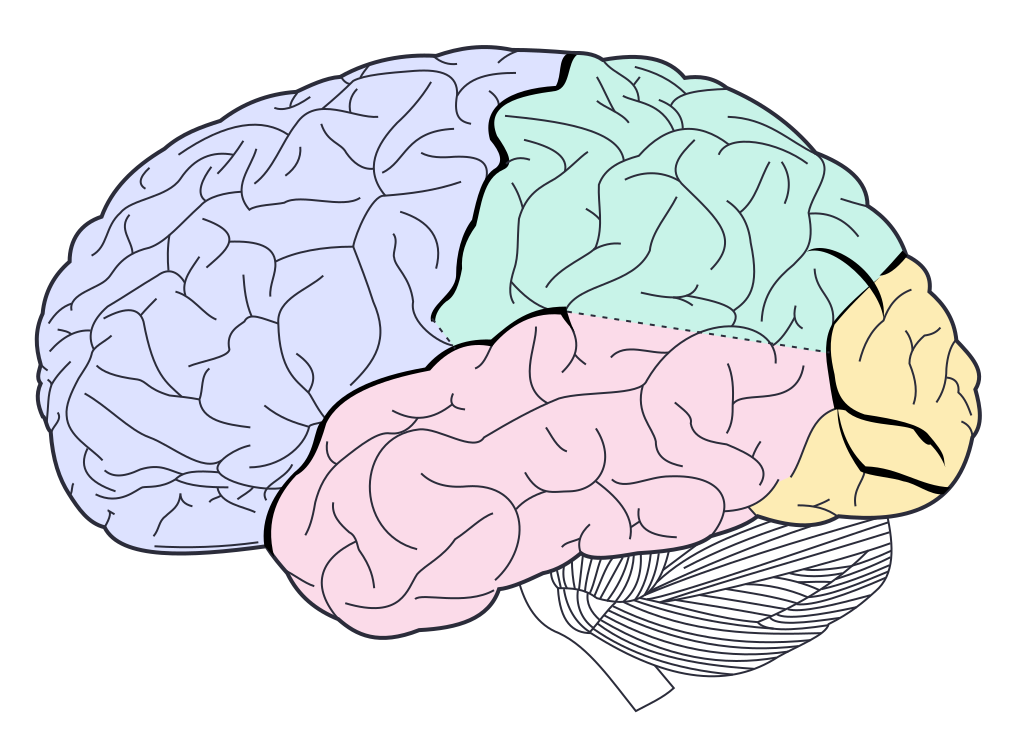
Based on Gray's Anatomy, fig. 728 (public domain)
INSIDE YOUR BRAIN
Spot the clash, then settle it
1
Read
Visual cortex sees the word
Visual areas at the back of the brain process the letters and the ink colour at the same time.
2
Detect
Anterior cingulate spots the clash
Deep in the middle of the frontal lobe, the cingulate notices that the two answers disagree: one of the most reliable findings in brain imaging.
3
Resolve
Prefrontal cortex takes control
The dorsolateral prefrontal cortex boosts the colour signal and holds back the word, so the right answer wins.
1935
A PhD project that never went out of date
John Ridley Stroop published the effect in his doctoral work at George Peabody College in Nashville. His participants named ink colours on printed cards while a researcher timed them with a stopwatch.
Stroop soon left psychology to teach and preach, but his 1935 paper became one of the most cited in the history of experimental psychology.
SourcesStroop, J. R. (1935). Studies of interference in serial verbal reactions. Journal of Experimental Psychology, 18, 643–662.MacLeod, C. M. (1991). Half a century of research on the Stroop effect: an integrative review. Psychological Bulletin, 109, 163–203.Botvinick, M. M. et al. (2001). Conflict monitoring and cognitive control. Psychological Review, 108, 624–652.MacDonald, A. W. et al. (2000). Dissociating the role of the dorsolateral prefrontal and anterior cingulate cortex in cognitive control. Science, 288, 1835–1838.
WHAT THIS GAME TRAINS
When reading gets in the way
Name the ink colour, not the word. Because reading is automatic, the word fights back: the Stroop effect, first published in 1935 and still one of psychology's most reliable findings.
corestrongsomelight
coreInterference controlOverriding the automatic urge to read.
coreSelective attentionFocusing on colour and ignoring meaning.
strongResponse inhibitionStopping the wrong answer before you say it.
someProcessing speedStaying quick despite the conflict.
THE SAME SKILL, ELSEWHERE
Three places this skill turns up
Each one leans on a different part of what the game trains.
Ignoring distractionsStaying on task when a notification grabs your eye.Uses interference control
Choosing your wordsSaying the right thing when a habit pulls the other way.Uses selective attention
Conflicting signalsFollowing the sign that matters when two disagree.Uses response inhibition