The further it turns, the longer you take
If you really rotate the picture in your head, your answer time should climb steadily with the angle, almost a straight line. Here's yours.
Now do it with your hands
Drag the slider to turn the green shape until it sits exactly on the outline. That smooth sweep is what your brain seems to do in the game, only silently, and in a fraction of a second.
Sometimes the outline is a mirror image. No amount of turning will make it fit: which is exactly how you know.
You rotate things all day
Each of these is a turn you make in your head. Hover a card to snap it back upright.
Reading a map
Heading south? You turn the map 180° in your head so it matches the road ahead.
Moving furniture
"Will the sofa fit through the door if we tip it on its end?"
Packing & puzzles
Spinning a jigsaw piece, or a suitcase in the boot, until it slots in.
Surgery & science
Surgeons, engineers and chemists picture 3D structures from every side.
Rotate smarter
Pick one anchor
Find one distinctive block, the yellow one, and track only that as you turn. The rest follows.
Turn the short way
Your brain rotates at a steady speed, so a smaller turn is a faster answer. Never go past 180°.
Check the handedness
Once it's upright, look at the anchor: is it on the same side? If it's swapped, you're looking at the mirror.
Accuracy first
Aim for 90% or better before you push for speed. A fast wrong answer teaches you nothing.
Your hands help you think
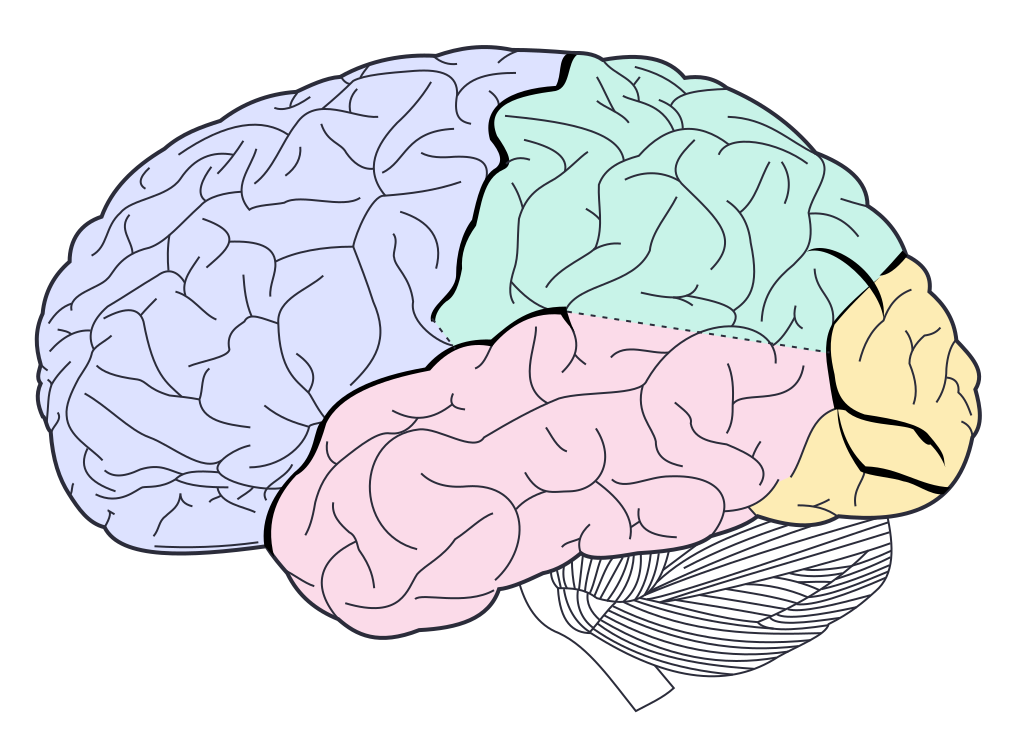
Rotating an image in your head borrows areas that plan real hand movements. Pick a region.
Roger Shepard and Jacqueline Metzler showed people pairs of 3D block shapes. Answer time rose in a near-perfect straight line with the angle, strong evidence that people really do "turn" mental images.
Shepard & Metzler, 1971A review of 217 studies found spatial skills improve with practice, the gains last, and they carry over to related spatial tasks.
Uttal et al., 2013Turning shapes in your mind
Is this the same shape rotated, or its mirror image? Since Shepard and Metzler's 1971 study, we've known people rotate the image in their heads: the further it's turned, the longer it takes.
More spatial games
All 40 games →Repeat a sequence of taps.
Remember where objects were placed.
Recreate a grid from a glance.
Complete the 3×3 grid of shapes.