Dorsolateral prefrontal cortex
Frontal lobeBoth sidesIts job
Updates working memory: adds the newest item and drops the oldest.
In this game
Slides your “window” forward every turn so you always compare with n steps back.
A square lights up. A letter is spoken. Did either one match what you saw n turns ago? Two streams, one mind, the purest working-memory workout there is.
Every turn you add one new item and drop the oldest. Drag the level to see which past turn you're comparing against.
Score 80% to climb. Below 50%, step down. Each rung roughly doubles the load.
Wayne Kirchner introduced the n-back task to study how people hold rapidly changing information in short-term memory.
Susanne Jaeggi and colleagues paired a visual and an audio stream. Dual n-back has since become one of the most studied working-memory training tasks.
Positions go in through your eyes, letters through your ears. Using separate senses stops the streams blurring together: and makes you coordinate both at once.
Where did the square light up n turns ago?
Which letter did you hear n turns ago? Muted? It shows on the square.
N-back is one of the most studied tasks in brain imaging. Because you track positions and letters at once, it pulls in both sides of the brain (the spatial right and the verbal left) driven by the frontal lobes.
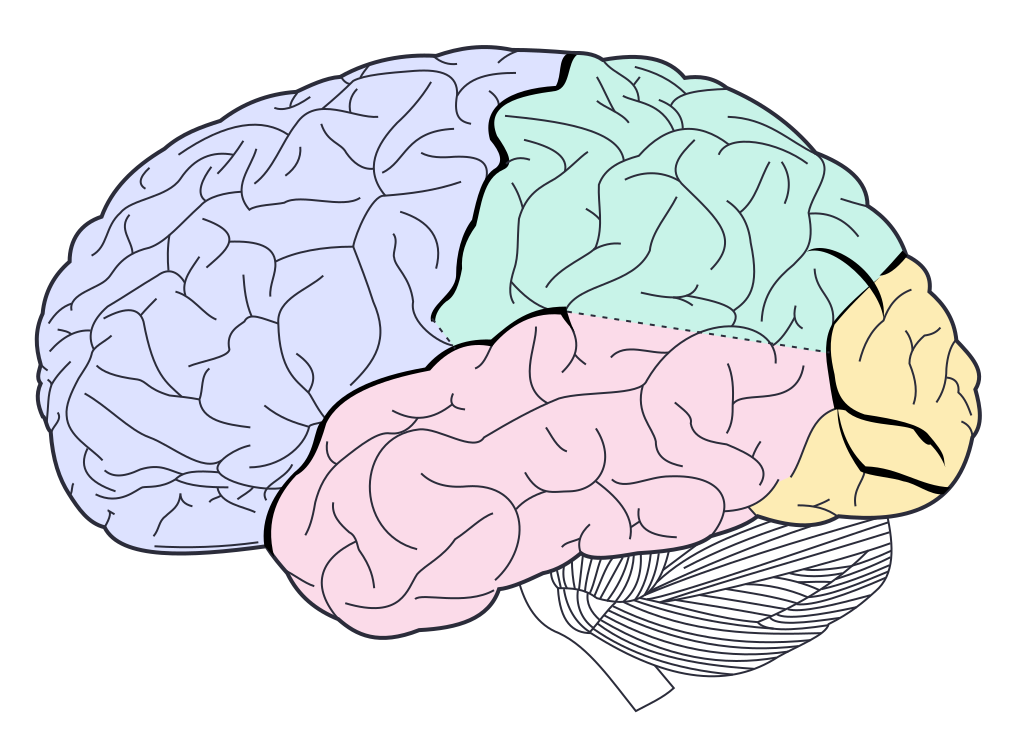
Updates working memory: adds the newest item and drops the oldest.
Slides your “window” forward every turn so you always compare with n steps back.
Holds locations and keeps attention on the task.
Keeps the last few square positions in mind.
Plans speech, including your silent inner voice.
Rehearses the recent letters as a short chant.
Monitors for conflict and mistakes.
Flags a possible match and helps you catch false alarms.
Prefrontal and cingulate regions update the stream and decide when to press.
The parietal cortex keeps positions (and helps with letters) ready for comparison.
After weeks of working memory training, imaging studies have found increased activity in prefrontal and parietal regions.
Research programmes use about 20 minutes a day, five days a week. Start at 2-back; most players reach 3-back within two weeks.
Track a position and a sound at the same time, and flag when either matches n steps back. It's one of the most demanding working-memory games there is.
Hear a string of digits and repeat it back, one longer each round.
Repeat it forwards, then backwardsBlocks flash in sequence. Tap them back in the same order.
Spatial working memoryCheck a sum, remember a letter, then recall every letter in order.
Memory under distractionHear a mix of letters and numbers; say numbers in order, then letters.
Hold and reorder