Processing Speed

Trail Making - Processing Speed

Connect items in order: 1→2→3 (Trail A) or 1→A→2→B (Trail B). Clinical staple of speed and flexibility.

Trail Making

About this exercise

Trail Making was originally part of the Army Individual Test Battery (1944) and is one of the most-used clinical neuropsychology tasks.

Part A measures pure visual scan speed. Part B (alternating numbers and letters) adds set-shifting and working memory.

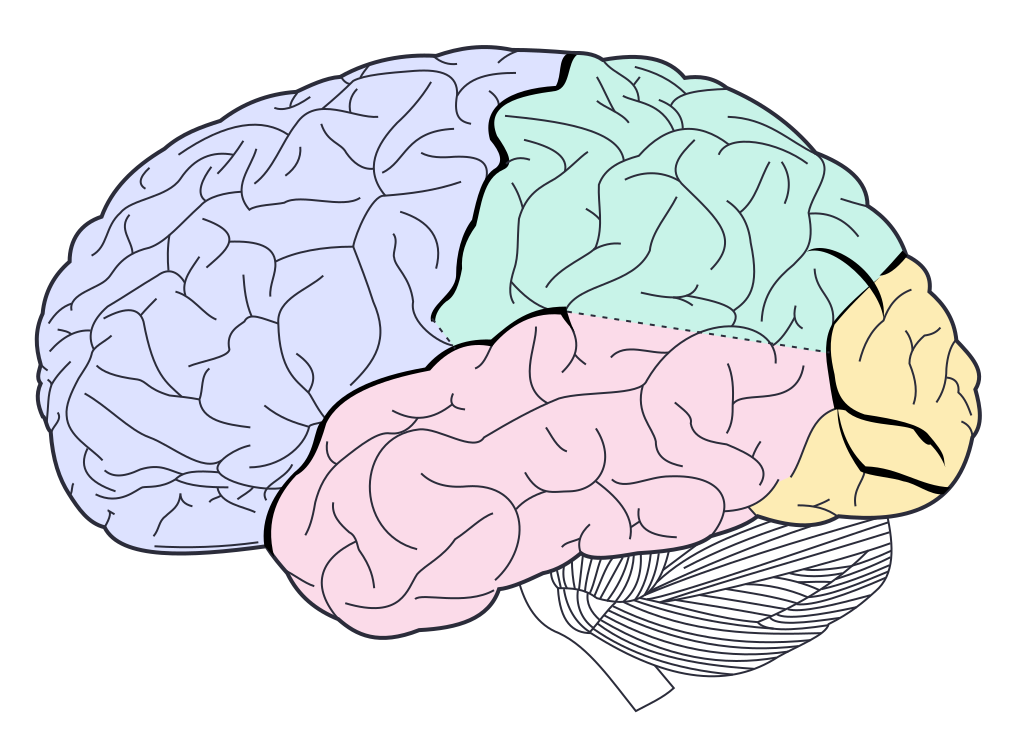
It's sensitive to frontal-lobe damage, ageing, ADHD, and concussion.

We track time, errors, and adjusted time (errors penalized).

The science

Reitan (1958) standardized norms still used today. Trail B/A ratio indexes executive function specifically.

Performance correlates with the dorsolateral prefrontal cortex and white-matter integrity.

What it measures

Visual search speed, sequencing, and on Trail B the flexibility to switch between two ordered series.

This task gauges how quickly your eyes scan a cluttered field, hold a sequence in mind, and guide the connecting line to the next target. A fast, error-free Trail A reflects efficient visual search and graphomotor speed: you locate the next number almost reflexively rather than re-scanning the whole array each step.

Trail B layers in alternation between numbers and letters, taxing working memory and set-shifting; the gap between your A and B times isolates that switching cost. Unlike a pure reaction task, performance leans heavily on organised scanning, which is why poor Trail B is a sensitive everyday marker of distractibility and divided-attention difficulty.

How to train it effectively

Master ordered scanning on Trail A before adding the switching load of Trail B.

Start on Trail A with a small set and aim for a clean, continuous line, not bursts of speed. Once your times plateau and errors approach zero, move to Trail B and to larger arrays. Focus on anticipating the next target while your hand finishes the current connection, so search and movement overlap rather than alternate.

The classic mistake on Trail B is losing your place in one series while hunting the other: you find the next number but forget which letter came last. Sub-vocalise the pair you are tracking (three, C, four, D) to keep both threads live. Slow down at switch points; that is where errors and backtracking cost the most time.

Interpreting your score

Completion time is the headline; the B-minus-A difference is the more telling number.

Read your own trend rather than chasing a universal cut-off, since times depend on array size, input device, and screen. A shrinking Trail A time signals faster search and sequencing. Watch the gap between your B and A times: when that difference narrows, your set-shifting and working memory are carrying the alternation more smoothly, independent of raw speed.

Scores swing with fatigue, caffeine, sleep, and using a mouse versus a touchscreen, so compare like sessions and look at multi-week averages. A strong time does not certify executive function clinically, nor does it speak to memory, reasoning, or vocabulary. It is one narrow window on processing speed and flexibility, not a verdict on overall ability.

How to play

  1. Watch the next-target indicator.
  2. Tap the targets in order.
  3. For Trail B: alternate numbers and letters (1, A, 2, B, 3, C…).
  4. Wrong taps cost 3 seconds each. Slow and accurate beats fast and wrong.