B3A1
Training/Working memory/Letter–Number Sequencing
Working memory≈4 minWechsler subtest

Letter–Number
Sequencing

A jumble of letters and numbers flashes by. Give it back sorted: numbers first, smallest to largest, then letters in alphabetical order.

B3A113AB
Difficultyspeed & start length
5–6
typical adult span
2
rules at once
–
your best
Length3items
HOLD, SPLIT, SORT

Three jobs in one answer

Digit Span asks you to hold a list. This asks you to hold it, split it into two groups and reorder each group — all in your head, before you answer.

STEP 1 · HOLD
D4B2F

Keep the whole jumble

Store it as it arrives, mixed together.

STEP 2 · SPLIT
42
DBF

Separate numbers and letters

Two mini-lists instead of one long one.

STEP 3 · SORT
24BDF

Order each group

Numbers up, letters A to Z. This is the heavy lifting.

Six ways to sort faster

Don't wait until the end to start sorting. Try one method per round.

01

Split as you go

Drop each item into a “numbers” or “letters” pile the moment it appears, instead of holding one long jumble.

B → letters · 3 → numbers
02

Insert in order

Slot each new item straight into its sorted place. By the end, both piles are already ordered.

3, then 1 → “1 3”
03

Say two short chants

Rehearse the piles separately — “one, three” and “A, B”. Two short chants beat one long one.

“1-3 … A-B”
04

Numbers first, always

Lock in the rule: numbers come out first. Recall them, then switch attention to the letters.

1 3 → then A B
05

Picture a number line

Imagine the numbers as dots on a line and the alphabet as a row of blocks. Sorting becomes reading left to right.

•1 · · •3 · · ·
06

Check the count

Before submitting, count your answer. If one is missing, it’s usually the item that arrived in the middle.

4 shown → 4 typed?
INSIDE YOUR BRAIN

Which parts of your brain Letter–Number Sequencing uses

Holding the jumble uses the same speech-based memory as Digit Span. Sorting it calls in the frontal lobes — the part of working memory that manipulates, not just stores.
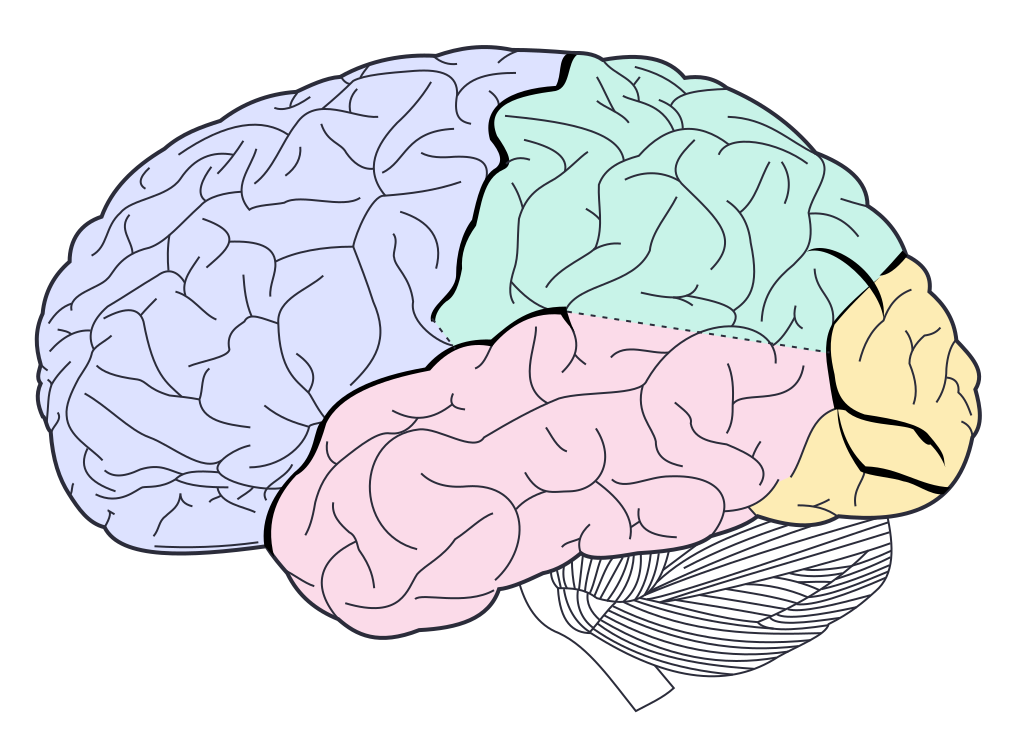
FRONTALPARIETALTEMPORALOCCIPITALCEREBELLUM
1
Based on Gray's Anatomy, fig. 728 (public domain)
1

Dorsolateral prefrontal cortex

Frontal lobeBoth sides
Its job

Manipulates what you’re holding — reorders, updates, sorts.

In this game

Splits the jumble and puts each group in order.

2

Broca’s area

Frontal lobeLeft side
Its job

Plans speech, including your inner voice.

In this game

Rehearses the letters and numbers as they arrive.

3

Supramarginal gyrus

Parietal lobeLeft side
Its job

A short-term store for speech sounds.

In this game

Holds the items while the frontal lobe sorts them.

4

Posterior parietal cortex

Parietal lobeBoth sides
Its job

Represents order and quantity.

In this game

Knows that 3 comes after 1 and C after B.

1997

From a research lab to the IQ test

James Gold and colleagues at the US National Institute of Mental Health designed the task to measure working memory that goes beyond simple repetition.

The same year it joined the third edition of the Wechsler Adult Intelligence Scale, where it still sits in the Working Memory Index alongside Digit Span.

SourcesGold, J. M., Carpenter, C., Randolph, C., Goldberg, T. E. & Weinberger, D. R. (1997). Auditory working memory and Wisconsin Card Sorting Test performance in schizophrenia. Archives of General Psychiatry, 54, 159–165.Wechsler, D. (1997). Wechsler Adult Intelligence Scale — Third Edition. The Psychological Corporation.Crowe, S. F. (2000). Does the letter number sequencing task measure anything more than digit span? Assessment, 7, 113–117.
WHAT THIS GAME TRAINS

Sorting in your head

Hear a mix of letters and numbers, then say the numbers in order and the letters in order. A Wechsler working-memory subtest that makes you rearrange, not just repeat.

corestrongsomelight
coreWorking memoryHolding and reordering a mixed list.
strongSequencingPutting items into numeric and alphabetical order.
strongAuditory attentionCatching every item you hear.
someMental flexibilitySwitching between sorting numbers and letters.
THE SAME SKILL, ELSEWHERE

Three places this skill turns up

Each one leans on a different part of what the game trains.

Sorting informationReordering a to-do list or set of steps in your head.Uses working memory
Codes and referencesRemembering mixed codes like postcodes or booking references.Uses sequencing
Rearranging plansReworking the order of errands as plans change.Uses auditory attention

Keep training working memory

All 40 games →
Sorting in your head is one piece of IQ
The full IQ test measures working memory alongside three other domains.
Take the IQ test →