01
1234
Shape
See a shape
Treat the lit blocks as corners of a letter or shape, a Z, a triangle, an arrow. One shape is far easier to hold than five separate spots.
In your head“a Z, left to right”
Blocks light up one after another. Tap them in the same order. Each success adds a block to the path. It's digit span, but for places, not numbers.
In Baddeley and Hitch's model of working memory, words and numbers go through a phonological loop, while places and shapes use a separate visuospatial sketchpad. Digit Span trains the first. Corsi trains the second.
Holds sounds, digits, words, a phone number you repeat under your breath.
Holds where things are, a route, the layout of a room, where you left your keys.
Blocks on their own are hard to remember; the path they make is easy. Try one per round, then keep the ones that work for you.
Treat the lit blocks as corners of a letter or shape, a Z, a triangle, an arrow. One shape is far easier to hold than five separate spots.
Follow the path with your gaze as it lights up, then replay the same eye movement when you tap. Your eyes rehearse the route for you.
Remember a long path as two short ones: the first three blocks, then the rest. Two small shapes beat one tangled line.
Label each jump with a direction, up, right, down-left. A few words back up the picture if it starts to fade.
Lay an imaginary 3×3 grid over the board and give each block a cell: top-left, centre, bottom-right. Positions become names.
Notice blocks that sit near a corner, an edge or right next to another block. Anchoring the path to landmarks stops it drifting.
Move a fingertip slightly along the path as it plays, without touching the screen. The movement gives your memory a second copy.
For backwards, don’t rebuild the path from scratch. Hold it as one movement, then play that movement in rewind from the last block.
How you practise matters as much as how long. Try this shape for each session.
Play one forwards round to find today's level. Your span shifts a little with sleep and focus.
≈1 minUse a single strategy from above for the whole round. Mixing methods mid-path usually breaks the chain.
≈1 minEnd with a backwards round. Reversing a path makes you hold and rework it, the hardest, most useful part.
≈1 minRemembering where leans on the right side of the brain, the mirror image of Digit Span. A network running from the back of the brain to the front maps the blocks, holds the order and moves your attention along the path.
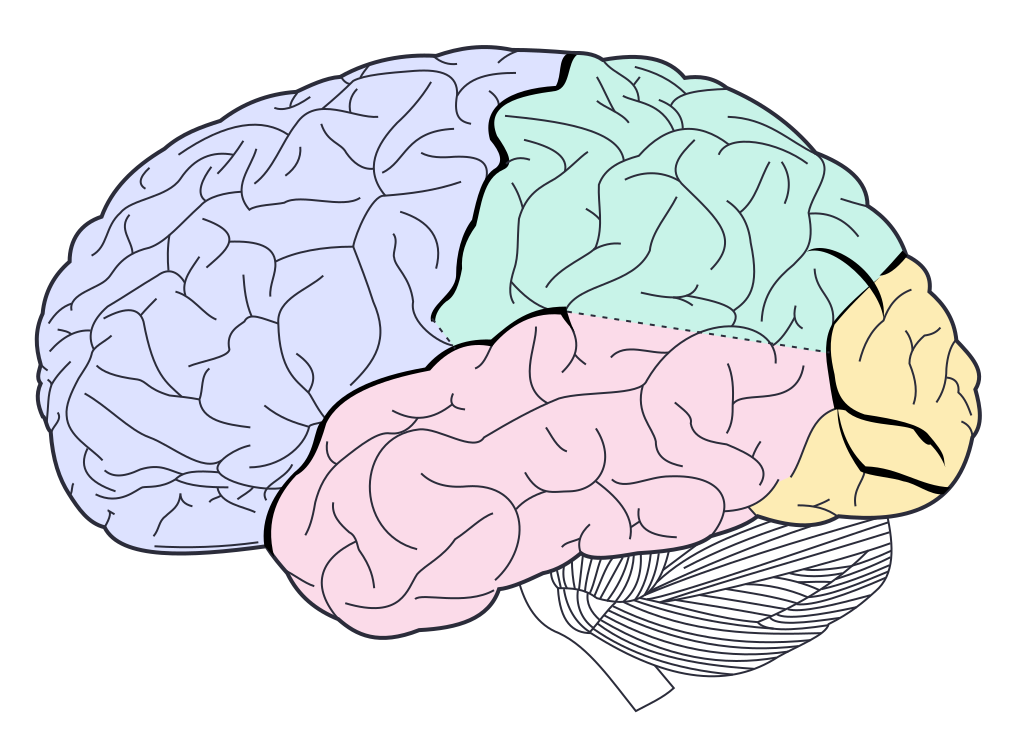
Builds a map of where things are around you.
Stores the position of each block as it lights up.
Moves your eyes and shifts your attention from place to place.
Traces the path with your gaze, why following it with your eyes helps.
Keeps a sequence in order and works on it.
Holds the order of the path and reverses it in backwards mode.
Learns layouts and routes so they last longer than a few seconds.
Corsi found people with right temporal lobe removals struggled to learn a repeated block path.
The prefrontal cortex and frontal eye fields keep the order and move your attention along the route.
The parietal cortex keeps the map of block positions active while you tap.
After weeks of working memory training, imaging studies have found increased activity in prefrontal and parietal regions.
Philip Corsi designed the test for his doctoral thesis at McGill University, working in Brenda Milner's lab. The examiner tapped wooden blocks on a board, and the patient tapped them back in order.
It showed that damage on the right side of the brain hurt memory for places more than memory for words. Clinics and labs still use it today, often on a screen like this one.
Blocks light up in sequence and you repeat the route. Since 1972 it's been the standard test of visuospatial span: the spatial partner of digit span.
Each one leans on a different part of what the game trains.