Every doubling of choices costs the same
Going from 1 to 2 lanes adds about as much time as going from 2 to 4. Reaction time grows with the doublings, bits of information, not the raw count.
How fast would you be with 10 buttons?
Hick's law lets you predict it. Slide the number of choices, the forecast uses your own round once you've played, or typical values until then.
Hick's law is everywhere
Menus & apps
Designers trim options because every extra choice slows people down.
Driving
Braking for a red light is simple; choosing to swerve left or right takes longer.
Sport
Penalty takers disguise their shot to force the keeper into more choices.
Ordering food
A long menu is slower to decide from, the reason many restaurants keep theirs short.
The extra step is choosing
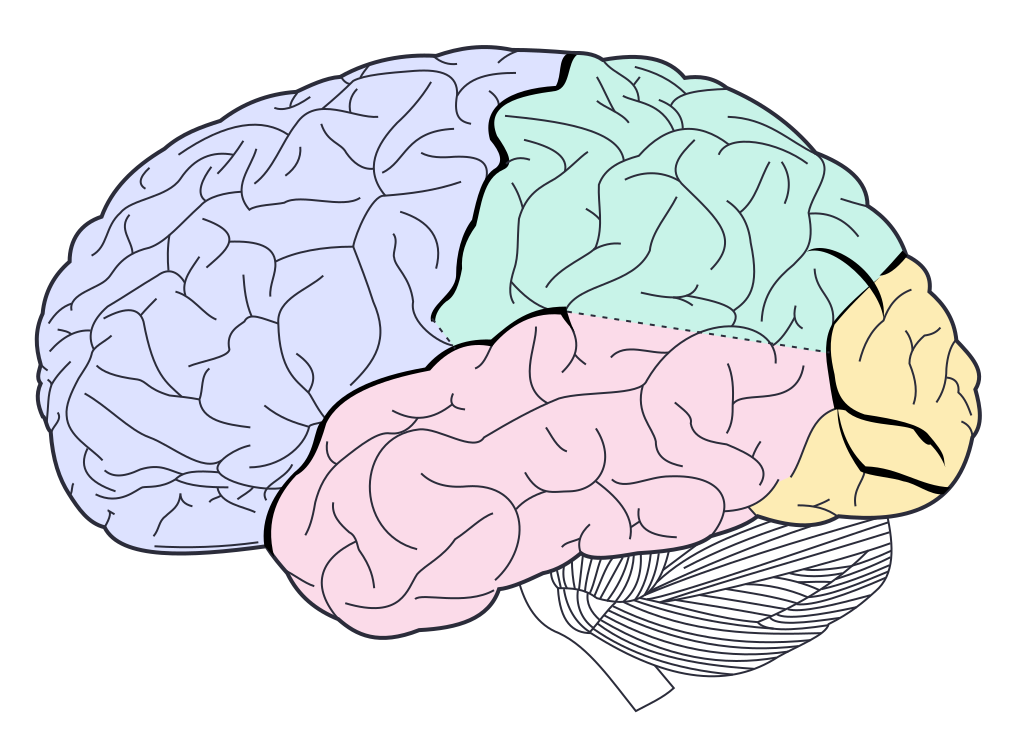
Simple reaction skips straight from seeing to moving. Choice reaction adds a selection step in between. Pick a region.
William Hick wired up to ten lamps, each with its own key, and found reaction time rose with the logarithm of the number of choices. Ray Hyman confirmed it a year later.
Reaction time = a + b × log₂(n + 1) in Hick's original form: a fixed cost, plus a cost per bit of uncertainty.
Speed when you have to choose
With more options, reactions slow in a predictable way (Hick's law). This game measures how quickly you can pick the right response from several.
More speed games
All 40 games →Tap the moment the screen changes.
Tap for targets, hold back for lures.
Respond to the centre arrow only.
Alternate rules without losing speed.