01
7294156
7294156
Group
Chunk
Group digits into pairs or triples as they arrive. Three chunks fit far more easily than seven singles, it’s why phone numbers are split up.
Digits flash one at a time. Type them back. Every time you get it right, the string grows by one. How long can you go?
In 1956 psychologist George Miller noticed that people hold about seven items at once, give or take two. Digit span is the simplest way to measure it. The trick to beating it isn't a bigger memory; it's chunking.
Hold the list as it came. Mostly a test of how much your short-term store can carry.
Hold the list and flip it. That extra mental work is why backward span runs one or two shorter.
Both directions appear in the Wechsler intelligence scales, where digit span is part of the Working Memory Index.
Strong players rarely have a bigger memory, they use a better method. Try one per round, then keep the ones that work for you.
Group digits into pairs or triples as they arrive. Three chunks fit far more easily than seven singles, it’s why phone numbers are split up.
Say the string silently, over and over, adding each new digit as it appears. Your inner voice keeps the whole run alive.
Give each chunk a beat, the way a phone number is read aloud. Rhythm glues digits into a single unit.
Picture each digit as a key on a phone keypad and trace the shape it makes. Shapes are easier to hold than lists.
Spot years, ages, times or familiar numbers hiding in the string. One meaningful chunk can replace four digits.
Hear “seven, two” as “seventy-two”. Two-digit numbers halve the words you need to rehearse.
Turn each digit into an image (2 a swan, 8 a snowman, 4 a sailboat) and link them into a quick scene.
For backwards, don’t flip the whole string at once. Chunk it forwards, then recall the last chunk first and reverse each one.
Any time you hold something in mind for a few seconds and act on it, you’re using the same system this game trains.
Keeping a verification code or phone number in mind long enough to type it.
“Second left, past the station, third door”, a sequence you hold and replay.
Carrying digits while you work on the rest of a sum.
Holding someone’s point in mind while you form your reply.
Brain-imaging studies show that holding digits mostly runs on the left side of the brain, the side that handles language. Forwards leans on speech areas; backwards calls in the frontal lobe to do the reordering.
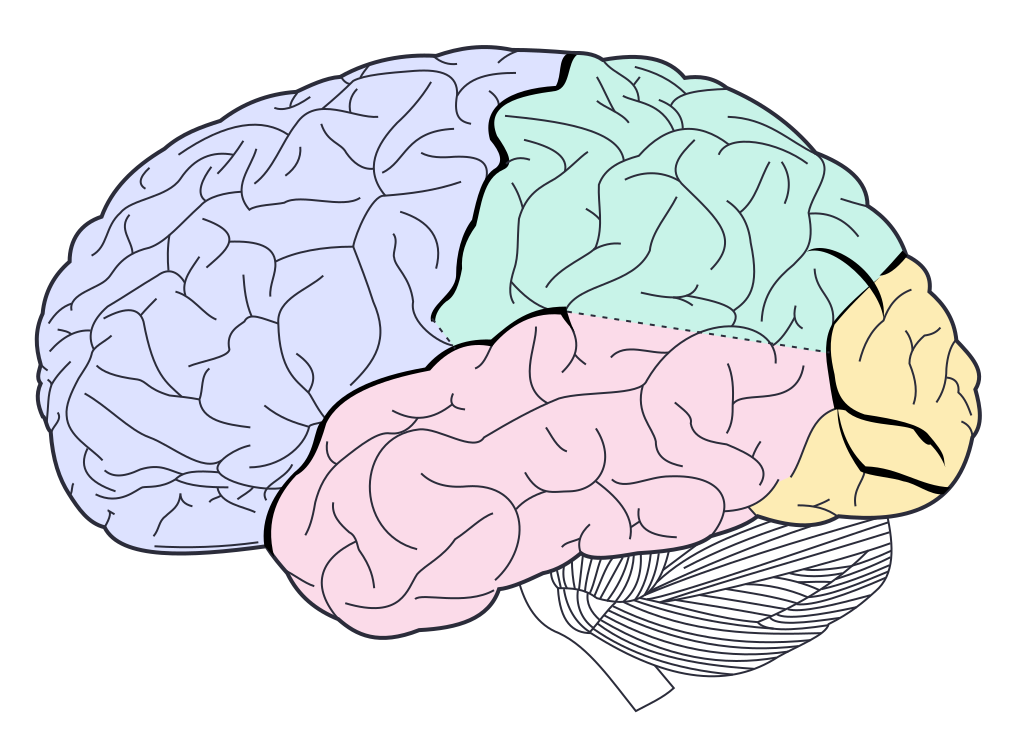
Turns light hitting your eyes into shapes you recognise.
Reads each digit in the fraction of a second it’s on screen.
Plans speech, including the silent inner voice you hear when you read.
Rehearses the digits “under your breath” so they don’t fade.
A short-term store for speech sounds, lasting a couple of seconds.
Holds the string itself while your inner voice keeps refreshing it.
Works on what you’re holding: reorders, updates and protects it from distraction.
Flips the order in backwards mode, the main reason backwards is harder.
Broca’s area and the prefrontal cortex keep the digits refreshed and, in backwards mode, rearrange them.
The left parietal lobe keeps the sound of the digits available for a few seconds.
After weeks of working memory training, imaging studies have found increased activity in prefrontal and parietal regions.
The game you just played has been measuring memory for well over a century.
Joseph Jacobs reads digits to pupils and records the longest string each can repeat.
Binet and Simon include repeating digits in their intelligence scale for children.
The Wechsler–Bellevue scale uses both directions, as its successors still do.
George Miller links span limits across many kinds of memory experiments.
Nelson Cowan argues that without chunking or rehearsal the true limit is about four items.
Hear or see a string of digits, then repeat it. Part of nearly every IQ test since the 1900s, it measures the size of your short-term verbal store.