Reactive Attention

Bubble Pop - Reactive Attention

Pop the bubbles before they vanish. Reactive accuracy and speed.

Bubble Pop

About this exercise

Bubble Pop trains rapid visual attention and motor accuracy under time pressure.

Bubbles spawn at random positions and shrink as they age. You must scan, prioritise, and tap before they vanish.

The misclick penalty forces precision - sloppy taps cost you. The score balances pace and accuracy.

Compared to grid-based reaction games, free-position spawning trains a wider attentional spotlight.

The science

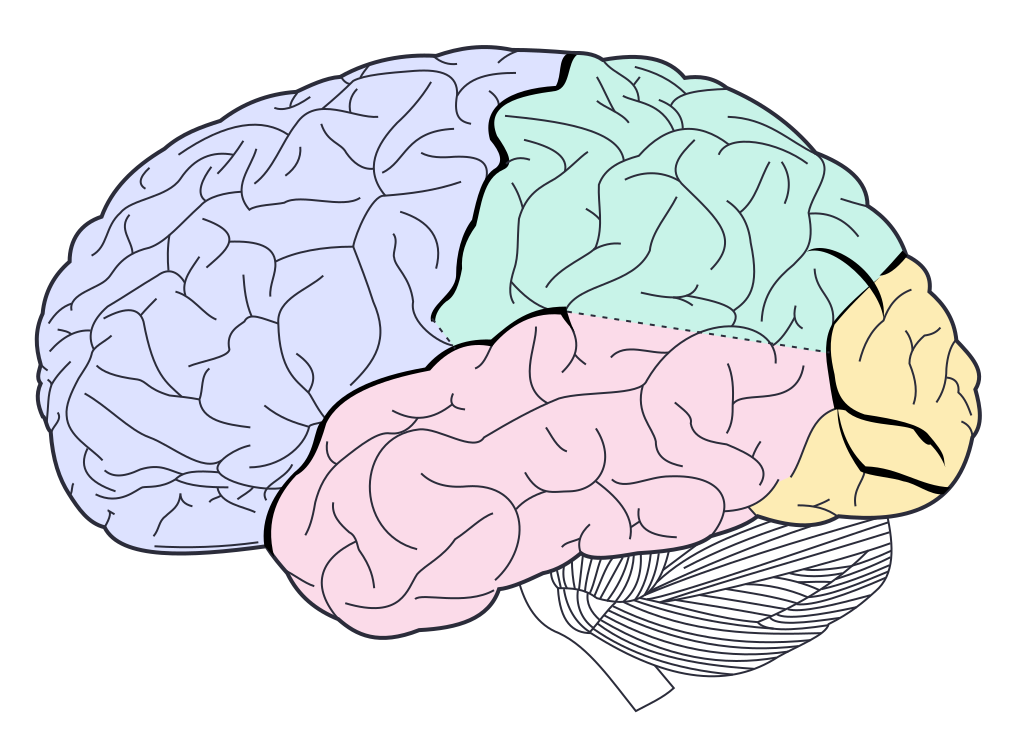
Reactive accuracy under time pressure recruits the fronto-parietal attention network and motor cortex in tight coordination.

Bubble-pop-style tasks correlate with sport performance metrics and are used in concussion baseline assessments.

What it measures

Bubble Pop isolates how fast you can turn a seen target into an accurate tap.

This task captures the full perception-to-action loop: detecting a transient target, localising it in space, and launching a precise motor response before it expires. Because bubbles appear at unpredictable positions and times, your result reflects orienting speed combined with pointing accuracy, not simple button-press reaction time to a single fixed stimulus.

Unlike a basic reaction-time test, where a target is expected at one location, Bubble Pop adds spatial uncertainty and a self-terminating deadline, so it taps visual search and aimed movement together. The closest everyday correlate is catching a dropped object or reaching for a moving item before it slips away.

How to train it effectively

Build accuracy first, then ask for speed without sacrificing it.

Start at a pace where you pop nearly every bubble cleanly, keeping your gaze loose and central rather than chasing each bubble. Only shorten the bubble lifespan or raise the spawn rate once you are clearing a level with few misses across a whole session. Treat consistent hit rate, not one lucky burst, as your signal to level up.

The common error is fixating hard on one bubble and tunnelling, which leaves you blind to the next spawn and creates a rhythm of late taps. Keep a soft, wide field of view and let peripheral motion pull your hand. Resist mashing the screen; stray taps on empty space usually cost more than the occasional miss.

Interpreting your score

Read your own trend, not a single session, against your personal baseline.

Your score blends how many bubbles you pop with how quickly you reach them, so look at both hit rate and average time-to-pop rather than the headline number alone. A strong result is a high hit rate held steady as difficulty climbs; rising misses at faster speeds simply marks the edge of your current loop, which is normal and movable.

Performance here is highly state-dependent: fatigue, caffeine, screen size, and touch latency all shift it, so compare sessions under similar conditions. A score reflects this specific reactive-pointing skill on this day. It does not measure sustained concentration, memory, reasoning, or general intelligence, and a good day does not certify a permanent gain.

How to play

  1. Bubbles appear at random spots in the field.
  2. Tap each bubble before it disappears.
  3. Misclicks count against your score - be precise.
  4. Prioritise the older, fading bubbles first.