Training/Attention/Posner Cueing

Posner
Cueing

Keep your eyes on the centre. A cue hints where a star will appear. Usually the hint is right — sometimes it lies. Press the side the star lands on, and see what a wrong hint costs you.

40 trials
+
Follow the arrow
An arrow in the centre points to where the star will probably appear. Keep your eyes on the centre and press F (left) or J (right) as soon as the star appears. 40 trials.
Press F for left, J for right — or tap a box
YOUR RESULTS

A good hint helps. A wrong one hurts more.

Three kinds of trial: an honest hint, a lying hint, and no hint at all. The gaps between them show your attention moving before your eyes do.

–Honest hint
–No hint
–Lying hint
BENEFIT–Faster when the hint was right — your attention was already waiting there.
COST–Slower when it lied — attention had to let go, move across, and re-lock.
YOUR TAKEAWAYPlay a round to see how much a hint helps — and how much a false one costs.

Attention works like a spotlight

Michael Posner described attention as a beam you can move without moving your eyes. Whatever sits in the beam gets processed faster and more clearly. Move your pointer over the panel to steer it.

Try to find the one R hidden among the other letters.

KHFEZTNLKHFEZTNLKHFEZTNLKHFEZTNLKHFEZTNLKHFEZRNLKHFEZTNLKHFEZTNLKHFEZTNL

Pulled or pushed?

The game has two cue types, and they drive two different attention systems. Switch between them above and compare your costs.

Top-downPushed by a goal
TriggerA symbol you have to interpret — the arrow.
SpeedSlower to kick in: roughly 300 ms.
ControlVoluntary. Ignore it if you know it lies.
Play with the arrow cue to see your cost here
Bottom-upPulled by an event
TriggerA sudden change right at the spot — the flash.
SpeedFast: works within about 100 ms.
ControlAutomatic. Hard to ignore even when useless.
Play with the flash cue to see your cost here
INSIDE YOUR BRAIN

The orienting network

Moving attention around space runs on a network across the top of the brain. Pick a region.
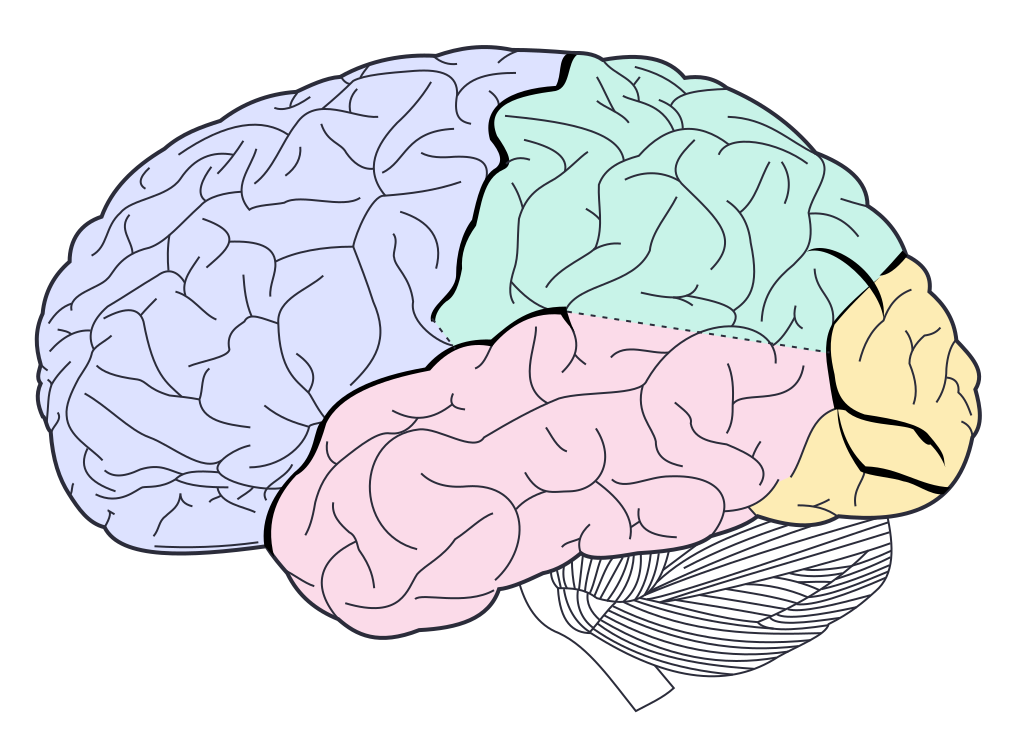
FRONTALPARIETALTEMPORALOCCIPITALCEREBELLUM
1
Based on Gray's Anatomy, fig. 728 (public domain)
1980the cueing task

Michael Posner showed people respond faster at a cued location even when their eyes don't move — proof that attention can shift on its own.

Posner, 1980
2 systems

A top-down network steers attention by goals (the arrow). A bottom-up network grabs it for sudden events (the flash).

Corbetta & Shulman, 2002
SourcesPosner (1980), Quarterly J. Experimental PsychologyCorbetta & Shulman (2002), Nature Reviews NeuroscienceKlein (2000), Trends in Cognitive Sciences
WHAT THIS GAME TRAINS

Where your attention goes before your eyes

A cue hints where a target will appear. When it's right, you're faster; when it's wrong, you pay a cost. The classic 1980 test of how attention shifts in space.

corestrongsomelight
coreSpatial attentionShifting focus to a cued location.
strongOrienting speedMoving attention quickly without moving your eyes.
strongDisengagingPulling attention back when the cue was wrong.
someResponse speedPressing as soon as the target appears.
BEYOND THE SCREEN

Where it matters most day to day

MOST COMMONHeads-up cuesTurning attention towards a sound or flash before you've looked.
GoalkeepingReading a player's body to guess which side the shot will go.
Following arrowsShifting attention to where a sign or gesture points.

More attention games

All 40 games →
Attention is one piece of the picture
The full IQ test measures four domains of thinking in about 30 minutes.
Take the IQ test →