Answer fast, then refocus
Spend as little time on each sum as you can. The longer you look away, the more the list fades.
glance · decide · back to letters
Check a quick sum, then see a letter. Another sum, another letter. At the end, recall the letters in order. Memory while you're busy, the way real life works.
In Digit Span you can rehearse freely. Here, every sum interrupts your rehearsal, so you have to protect the letters with attention instead. Psychologists call this a complex span task.
That's why it's shorter than digit span, and why it predicts reading comprehension and reasoning better than simple span tasks do.
Hold a list with nothing else to do.
Hold a list while solving something else.
The trick is protecting the list while your attention is on the sum. Try one per round.
Spend as little time on each sum as you can. The longer you look away, the more the list fades.
Say the letters silently in every tiny pause, while the next sum loads, before you tap.
Turn letters into a word or name as they arrive. K-R-P can become “KaRP”.
Group every two letters so a set of six is only three things to hold.
Research versions only count scores when maths accuracy stays high. Don't sacrifice the sums to save the letters.
If you blank on the recall screen, restart from the first letter, the sequence often comes back as a whole.
Switching between sums and letters puts the frontal lobes in charge. They keep the letters safe while other areas do the maths and store the list.
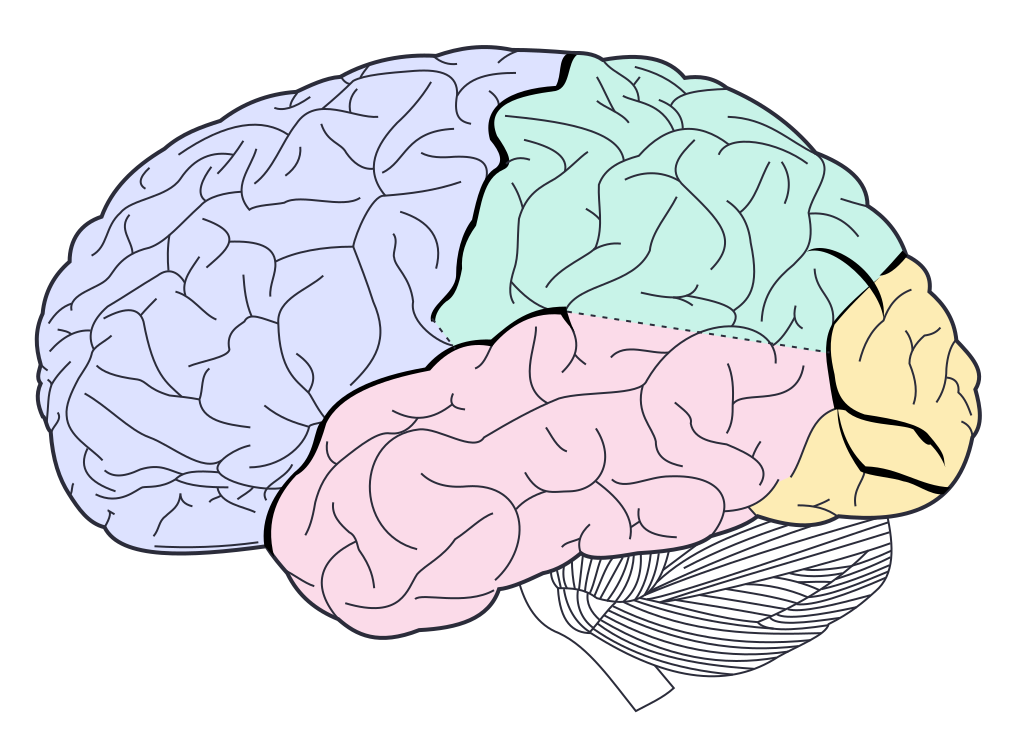
Guards what you’re holding against interference.
Keeps the letters alive while your attention is on the sum.
Notices conflict and switching demands.
Handles the constant jump between maths and memory.
Supports attention and number processing.
Helps check each sum quickly.
Plans speech, including your inner voice.
Rehearses the letters in the short gaps between sums.
Marilyn Turner and Randall Engle introduced operation span at the Georgia Institute of Technology. They wanted a memory test that tracked how well people actually think, not just how many items they can repeat.
Complex span scores went on to predict reading comprehension and fluid reasoning, and an automated version from 2005 became a standard research tool.
Solve a simple sum, then remember a letter; repeat. Recall the letters at the end. Because you're processing and storing at once, it's one of the best measures of working-memory capacity.
Tap a situation to see which part of the skill it relies on.