Here’s how a puzzle works
Dark rows are the rules doing the work; the pale row is a feature held constant. Play the game above and this panel explains your own last puzzle.
Almost every matrix uses four kinds of rule
Learn to spot these and most puzzles collapse into a quick checklist. Each strip below is one row from a matrix.
Progression
Something grows or shrinks step by step — here the count goes 1, 2, 3.
Distribution of three
Three values appear once each in every row, in a different order each time.
Constant
Some things never change. Spotting them early tells you what to ignore.
Combined
Two rules at once — count rises while the fill rotates. Solve them separately.
Solve it before you look at the answers
The six options are designed to trap you: each wrong one is off by a single detail. Strong solvers build the answer in their head first, then go and find it.
- 1
Scan one row
Look across the top row only. What changes from tile to tile?
row 1: ● → ●● → ●●● - 2
Name every change
Check each feature separately: count, shape, fill. Say each rule out loud.
count ↑ · shape same · fill same - 3
Check the columns
Confirm the rules hold down the columns too — some rules only run one way.
col 1: circle, square, diamond - 4
Predict, then find
Build the missing tile in your head. Only now look at the six options.
expect: 3 × striped diamond
The puzzle that measures reasoning without words
No reading, no vocabulary, no maths — just shapes and rules. That's why matrices are among the most widely used reasoning tests in the world.
Raven’s matrices
John C. Raven publishes his Progressive Matrices to measure reasoning free of language and schooling.
The Flynn effect
James Flynn shows scores on matrix tests rose by roughly three IQ points per decade across many countries.
Why they’re hard
Carpenter, Just and Shell find top solvers aren’t faster — they keep more rules in working memory at once.
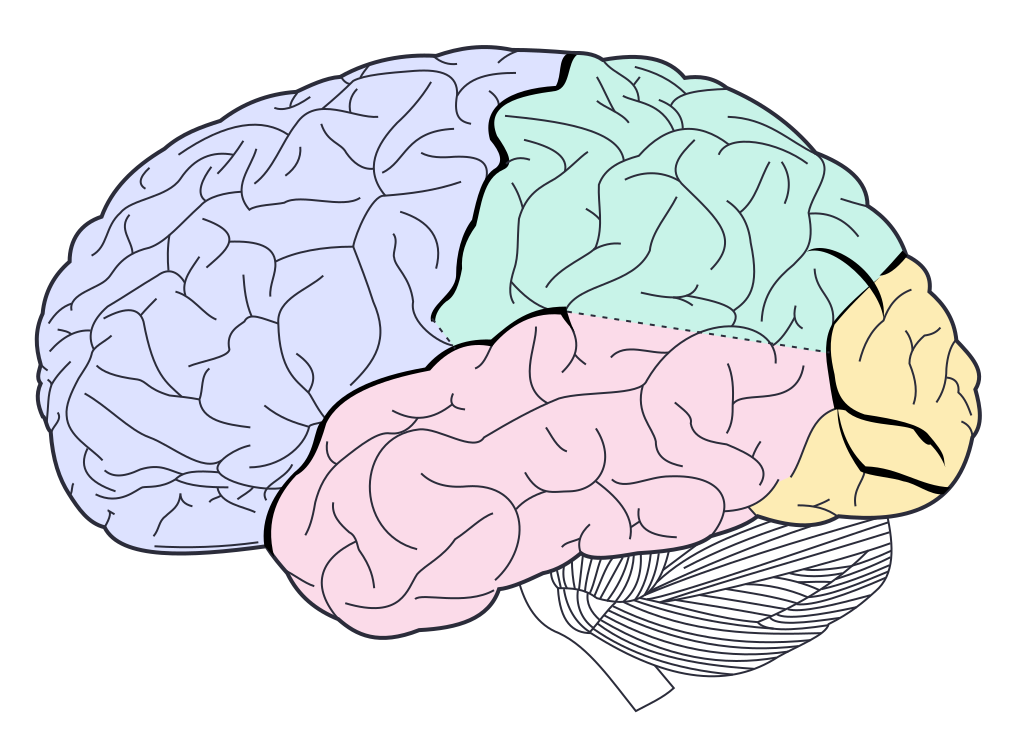
The front–back reasoning loop
Reasoning tests light up a network linking the front and back of the brain. Pick a region.
Finding the rule in a pattern
Spot the rule that runs across the rows and columns, then pick the missing piece. Matrix puzzles are a core part of many IQ tests, from Raven's to the Wechsler scales.
Moments that use the same skill
More pattern games
All 40 games →Find the next item in a figure series.
Which figure breaks the rule?
Are the two shapes the same, rotated?
Track position and sound, n steps back.