Misses are usually near misses
Spatial memory stores a rough region first and the exact square second. Your picks this session, by distance from the right square:
Play a round to fill in the chart.
Your best memory is for places
Since ancient Greece, orators have stored speeches by "placing" each point along a route through a familiar building. Memory champions still use it today. Walk the route below to see how a shopping list sticks.
A carton of milk is jammed in the letterbox, dripping onto the mat.
Four ways to pin a position
Use the corners
Code positions from the nearest corner: "one in from top-left".
Spot the shape
Link three objects into a line, triangle or L.
Row, then column
Say it like a map reference — row 2, column 4.
Tell a mini story
The apple rolled from the bell to the umbrella.
A map inside your head
Three regions share the work every time you place an object. Pick one to see its job in this game.
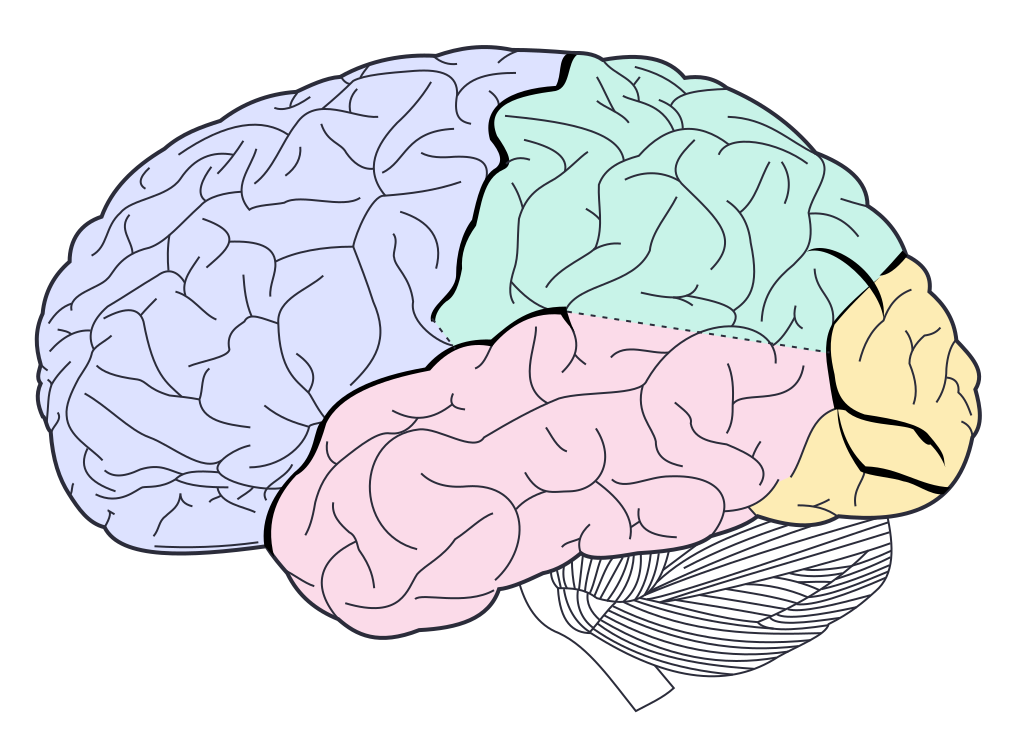
That's what taxi drivers memorise for "The Knowledge". Brain scans found a larger rear hippocampus in taxi drivers than in bus drivers, who follow fixed routes.
Maguire et al., 2006Awarded for discovering the brain's positioning system — "place cells" that fire at one spot, and "grid cells" that tile space like graph paper.
O'Keefe, May-Britt Moser & Edvard MoserRemembering where
Objects appear in places, then vanish. Put each one back where it was. It trains location memory, the kind you use for finding things again.
Pick a moment to see what's going on
Tap a situation to see which part of the skill it relies on.
More memory games
All 40 games →Find matching pairs by position.
Recreate a grid from a glance.
Repeat a sequence of taps.
Read a story, recall the details.