Pattern Recognition

Number Estimation - Pattern Recognition

Don't compute - estimate. Pick the answer closer to the truth without solving exactly.

Number Estimation

About this exercise

Number sense - magnitude estimation without exact calculation - is a foundational math skill that develops in childhood.

You see a problem (e.g., 73 × 47) and pick which of two answers is closer to truth. The wrong answer is in the right ballpark, so guessing fails.

Skilled estimators round and re-anchor (73 × 47 ≈ 70 × 50 = 3500).

Often discussed in relation to later math learning and quantitative development.

The science

Halberda et al. (2008) linked number sense in childhood to math achievement years later.

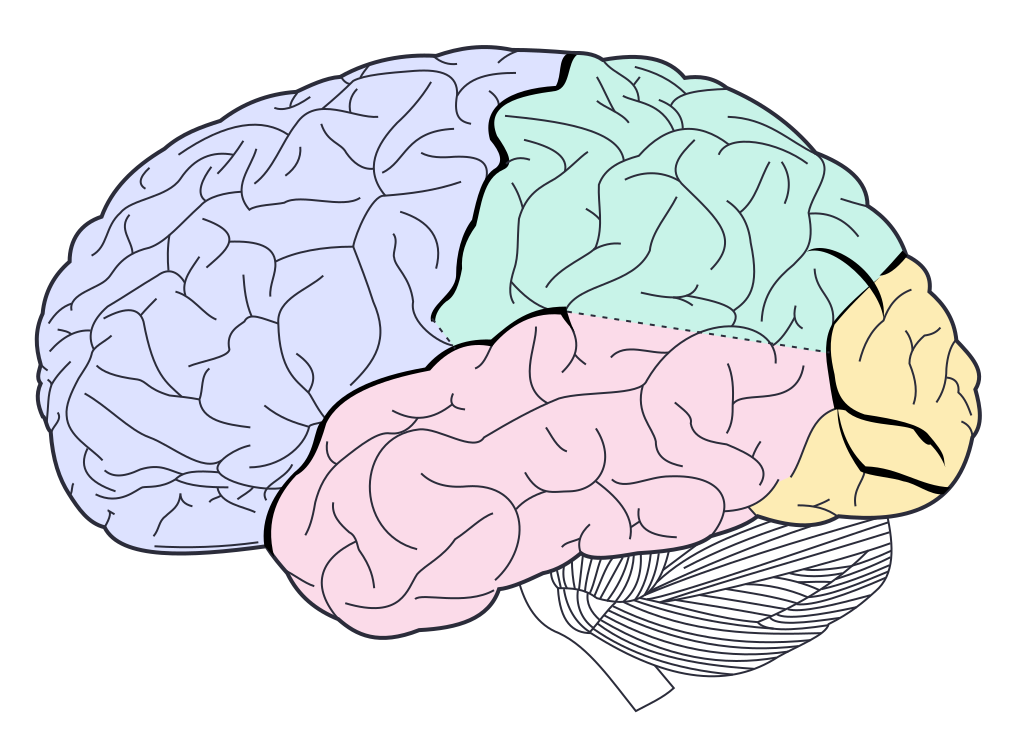
The "approximate number system" is a separate cognitive ability from exact arithmetic, residing in parietal cortex.

What it measures

How well you judge magnitude quickly without exact calculation.

Number estimation taps the approximate number system: gauging which quantity or answer is closer to the truth by sense rather than computation. A strong result reflects sharp magnitude intuition, the ability to compress a problem into a rough scale and pick the nearer option before any exact arithmetic could finish.

This differs from the mental-math sprint, which rewards precise calculation. Here precision is the wrong tool; the task punishes you for computing when you should approximate. Approximate magnitude sense correlates with formal mathematics ability and underlies everyday judgements like whether a bill looks right or a quantity is plausible.

How to train it effectively

Commit to estimating; resist the pull to calculate exactly.

Practise rounding aggressively and comparing scales rather than digits: judge orders of magnitude and leading figures first. Build speed by trusting a rough answer and checking only the gap between options. As you improve, shorten the time you allow yourself so the intuitive system, not deliberate arithmetic, drives the choice.

The defining mistake is trying to compute the exact value, which burns time and defeats the task. Another is over-rounding both options the same way so the difference vanishes; round enough to compare but keep what distinguishes them. Trust the first strong sense of which is larger, then verify only the margin.

Interpreting your score

Accuracy under time pressure is the real measure, not slow correctness.

Because the point is fast approximation, read accuracy together with speed: getting most items right quickly beats getting all right slowly by calculating. Strong estimators stay accurate as the options get closer together and the clock tightens. Track whether you hold accuracy while answering faster, which shows genuine intuition gains.

Scores vary with attention and how close the answer options are on a given run, so judge across many trials. The result reflects magnitude intuition on this format; it is not a measure of calculation skill or broader mathematical knowledge, which draw on more deliberate, precise processes.

How to play

  1. Read the problem.
  2. Don't compute exactly - round and approximate.
  3. Pick the answer closer to truth from two options.
  4. Speed counts - estimation is supposed to be fast.