First and last stick. The middle sinks.
Early words get the most rehearsal (primacy). The last few are still in short-term memory (recency). The middle gets neither. Your own recall, by position, shows up here.
Chain the words into a story
A list has no glue. A story does. Link each word to the next with a strange little scene.
Four ways to beat forgetting
Space it out
Review after an hour, a day, then a week. Gaps beat cramming.
Test yourself
Trying to recall strengthens memory more than rereading.
Sleep on it
Sleep helps the brain replay and store what you learned.
Make it visual
Turn each word into a vivid picture or scene.
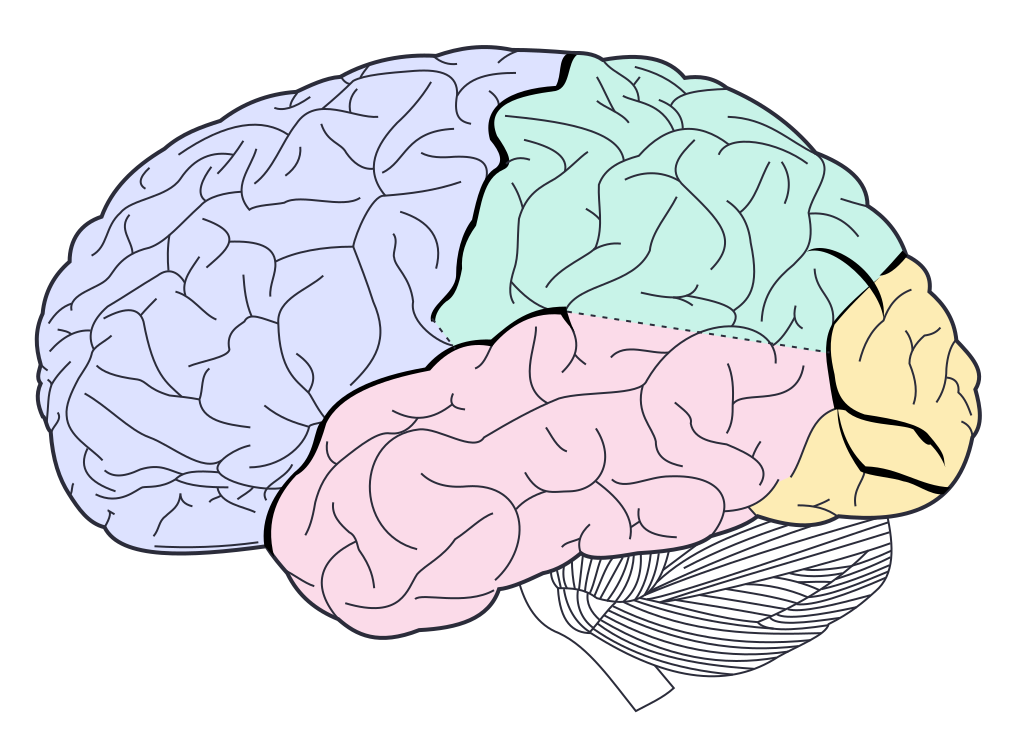
Where the list goes
1 · Hippocampus stores the early words for the long term. 2 · Prefrontal cortex organises and searches during recall. 3 · Broca's area rehearses the most recent words.
In 1885 Hermann Ebbinghaus memorised lists of nonsense syllables to measure forgetting on himself. In 1962 Bennet Murdock charted the U-shaped curve above.
Sources
- Ebbinghaus, H. (1885). Über das Gedächtnis. Duncker & Humblot.
- Murdock, B. B. (1962). The serial position effect of free recall. Journal of Experimental Psychology, 64, 482–488.
How many words you can remember
Learn a list, recall it, learn it again. Word-list tasks show how memory builds with repetition and which words stick: usually the first and last.
Three places this skill turns up
Each one leans on a different part of what the game trains.
More memory games
All 40 games →Meet faces, then recall their names.
Repeat growing strings of digits.
Tap blocks back in the order they lit.
Recreate a grid you saw for a moment.