Training/Attention/Useful Field of View

Useful Field
of View

In one quick flash, a car or a truck appears in the centre — and a second car appears somewhere near the edge. Say which vehicle was in the middle, then where the other one was. The flash gets shorter as you improve.

Difficultyspots & speed
Field sizewider = harder
24 trials250 ms
+
One glance, two jobs
Look at the + in the centre. A car or truck will flash there, with a second car somewhere on the ring. First say what was in the middle (F / J), then tap where the outer car was. 24 trials.
YOUR FIELD OF VIEW

How wide you see in a glance

Each spoke shows how often you placed the outer car correctly in that direction. Most people have a weaker side or corner — often without knowing it.

–CENTRE
–Flash thresholdShortest glance you handled well
–Edge accuracyOuter car placed correctly
–Centre accuracyCar or truck named correctly

Play the game above to draw your map.

Busy mind, narrow view

Your useful field of view isn't fixed. When the task in the centre gets harder — heavy traffic, a phone call, rushing — the area you can take in at a glance shrinks. It's a kind of tunnel vision that happens in the mind, not the eyes.

Relaxed — wide view4 of 6 hazards in view
THE ACTIVE TRIAL

One of the best-studied brain-training tasks

This exact kind of task — speed-of-processing training — was one of three methods tested in a large, long-running study of older adults.

2,832older adultsAged 65 to 94, randomly assigned to memory, reasoning or speed training — or none.
10 hrsof trainingTen sessions of about an hour, with a few later "booster" sessions.
10 yrsof follow-upGains in processing speed were still measurable a decade later.
Fewerat-fault crashesSpeed-trained drivers had fewer at-fault car crashes in follow-up records than the control group.
SourcesBall et al. (2002), JAMABall, Edwards, Ross & McGwin (2010), J. American Geriatrics SocietyRebok et al. (2014), J. American Geriatrics Society
INSIDE YOUR BRAIN

Centre and edge, at the same time

Splitting attention between the middle and the edges in a single glance takes several regions working fast. Pick a region.
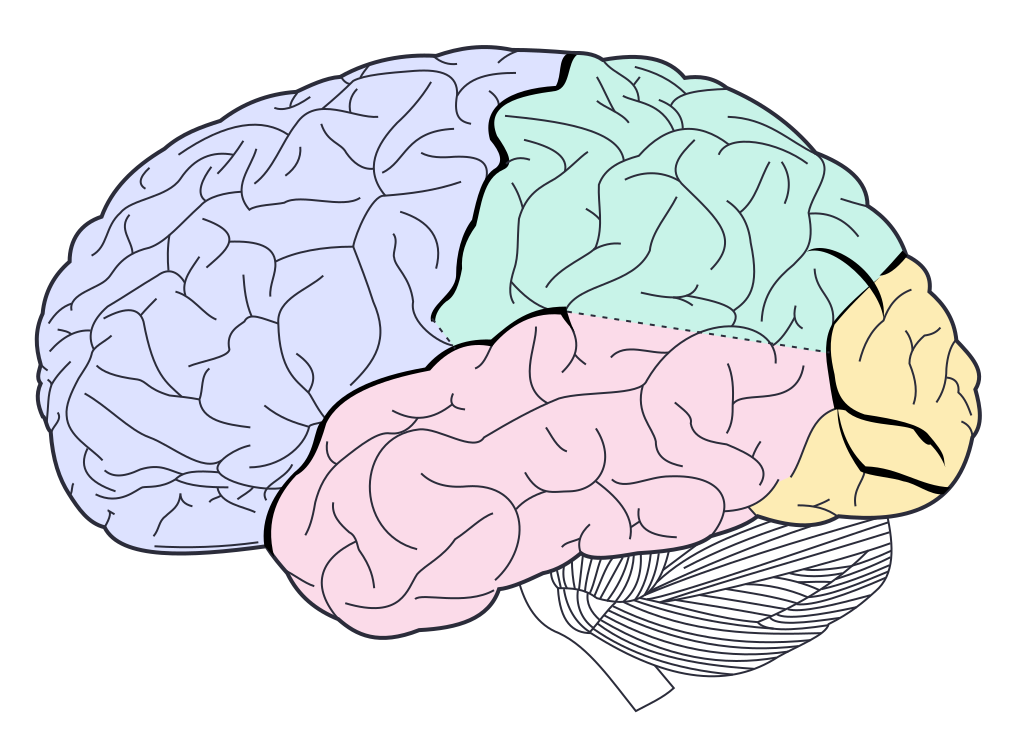
FRONTALPARIETALTEMPORALOCCIPITALCEREBELLUM
1
Based on Gray's Anatomy, fig. 728 (public domain)
WHAT THIS GAME TRAINS

How much you take in at a glance

Spot a central target and a peripheral one in a single brief flash. UFOV measures the area you can process at once, and it's closely linked to driving safety in older adults.

corestrongsomelight
coreVisual processing speedTaking in a scene in a fraction of a second.
coreDivided attentionHandling the centre and edge at once.
strongPeripheral awarenessCatching what's off to the side.
strongSelective attentionIgnoring clutter around the target.
ON AN ORDINARY DAY

Moments that use the same skill

MOMENT 01“Driving”Noticing a car or cyclist at the edge of your view.
MOMENT 02“Crowded places”Moving through busy streets without bumping into things.
MOMENT 03“Busy shops”Taking in shelves, signs and people around you while you walk.

More attention games

All 40 games →
Attention is one piece of the picture
The full IQ test measures four domains of thinking in about 30 minutes.
Take the IQ test →