Every answer has a reason
A correct pick is only half the skill, being able to say why is the other. Here's the rule behind each puzzle you played.
Change the lens, change the answer
In this set, each feature points to a different "odd" figure. Switch between them. A good puzzle has exactly one lens where four figures agree completely, that's the real rule.
When you're stuck, go through the lenses one at a time instead of staring at the whole picture.
Check features in this order
From what your eye catches instantly to what you have to reason out. Most puzzles are solved by step two; the hard ones live at the end.
Shape
Circles, squares, diamonds, the eye sees this first.
Fill
Solid, outline or striped.
Count
How many, and whether it’s odd or even.
Pairings
Does one feature decide another? "All circles are solid."
Relations
Rules across figures, like mirror pairs or sums.
Your brain loves an oddball
Something that breaks a pattern triggers a distinct burst of brain activity. Pick a region.
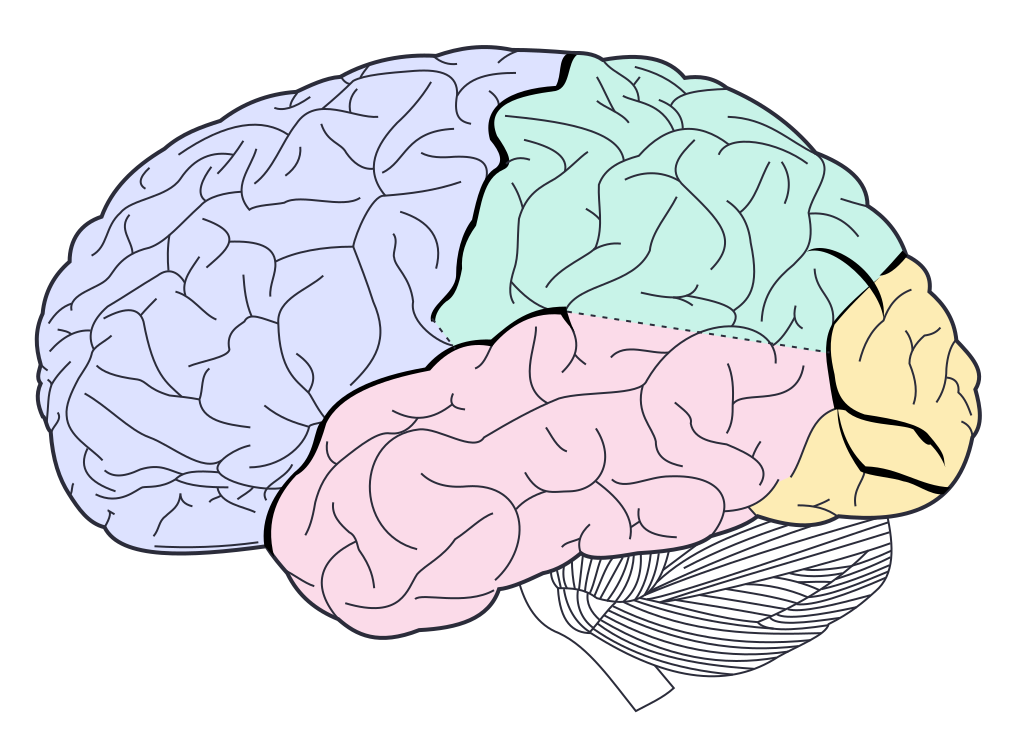
About 300 ms after you notice something that doesn't fit, a positive wave appears in brain recordings. It's one of the best-studied signals in neuroscience.
Sutton et al., 1965An item that differs in one simple feature jumps out instantly. When the difference is a combination of features, you have to search item by item.
Treisman & Gelade, 1980Spotting what doesn't belong
Find the item that breaks the pattern. It sounds easy, but it means working out what the others have in common first, the essence of classifying.
Where it matters most day to day
More pattern games
All 40 games →Complete the 3×3 grid of shapes.
Find the next item in a figure series.
Find the odd item in a crowded field.
A is to B as C is to…?