Which Grid Comes Next in the Sequence?
Which Grid Comes Next in the Sequence?
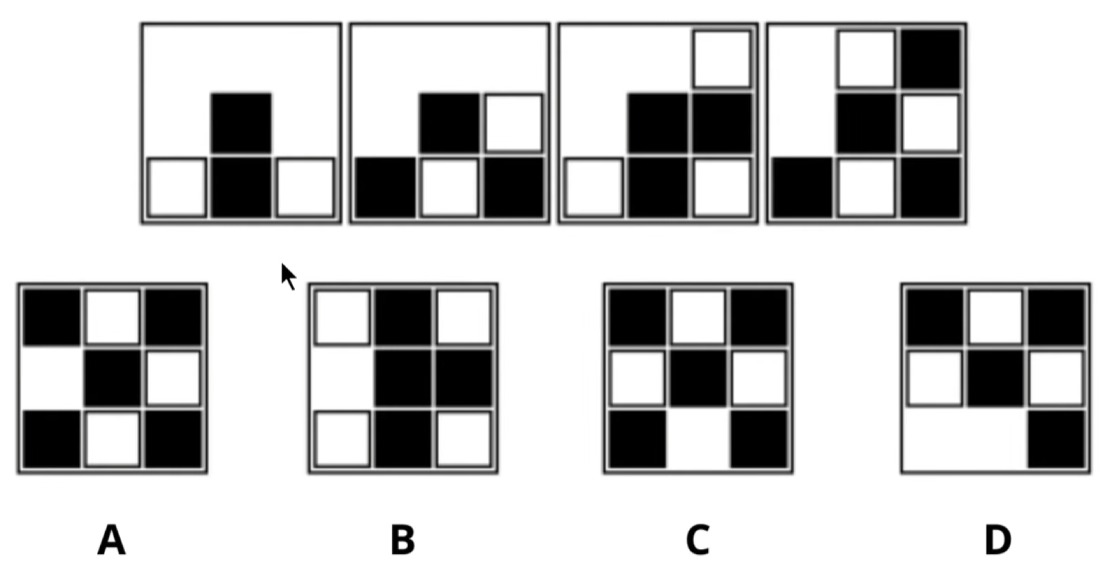
Question: Study how the grid develops from one figure to the next. Pay attention not only to the new squares being added, but also to how the colors of the existing squares change. Which option correctly continues the sequence?
Report this question
Tell us what's wrong and we'll review it.
Explanation
Community Solutions We shared this puzzle with the Reddit community and received a variety of answers and approaches. After reviewing the responses, we selected three explanations that stood out for their clarity, reasoning, and unique ways of approaching the pattern. lemasney The answer is B: The center black square can be set aside. It’s present throughout, and we have no reason to believe it would change; it’s a spinning hub. In the pattern, the white squares are traveling counterclockwise around the center square. They are presumably entering from the lower left space. After each white square enters the race, a black square follows suit, then white, then black, and so on. B is the only answer in which a fourth white square appears, which is what the pattern predicts. Why we selected this answer: We selected lemasney’s answer for its creative and intuitive interpretation of the pattern. Describing the fixed center square as a “spinning hub” provides a clear way to visualize how the surrounding squares progress counterclockwise. The explanation also connects the movement, alternating colors, and appearance of the fourth white square to reach B. ⸻ Mactucrus87_ B 1. The cubes alternate between black and white. 2. The central cube is always black. 3. Every step adds a cube, initially white. In the 5th step we would have a new white cube high on the left. The central cube would be black. The other cubes would be inverted in color, so white in the corners and black in the middle of the sides. Why we selected this answer: We selected Mactucrus87_’s answer because it breaks the sequence into three clear rules: color alternation, the permanently black center, and the addition of a new white square at each step. Applying these rules makes the prediction of B systematic and easy to verify. ⸻ AdEmotional8815 B What did I use? Lets name the first pictures 1 to 4: So 1 gets to 3, and 2 gets to 4; adding black squares and not moving them around. So to get to 5 I go from 3. And that would only fit B, because it’s the only one that also has 2 black squares in the middle of the last and second last line. And yes, I completely ignored the white squares. Why we selected this answer: We selected AdEmotional8815’s answer because it reaches B through a distinctly different method. Instead of treating the figures as one continuous progression, it identifies 1→3 and 2→4 patterns and predicts figure 5 from figure 3. By focusing only on the black squares and deliberately ignoring the white ones, it provides an interesting alternative route to the same answer.
Community Solutions (0)
No solutions yet. Be the first to contribute!
Submit Your Solution
Have a different approach or want to help others understand? Share your explanation.