Official explanation
Community Solutions
Several people found the correct answer, but these three explanations stood out because they approached the pattern from different angles.
Cyrrex91
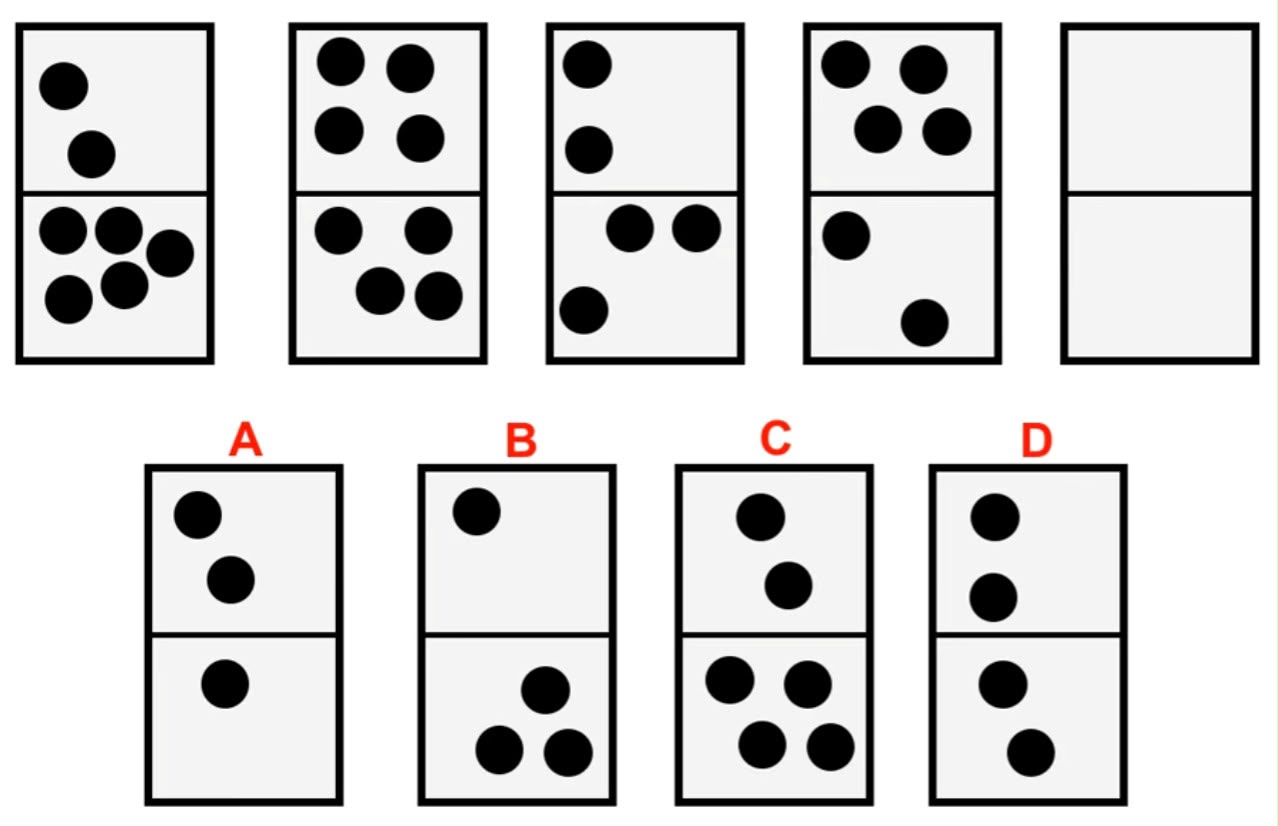
“A because the pattern 7 8 5 6 therefore it continues with 3 4 and then theoretically with 1 2
so A is the only domino that has a face sum of 3”
Why we selected this explanation:
Cyrrex91 found an alternative pattern that most solvers did not mention. Instead of treating the upper and lower halves separately, they looked at the total number of dots on each tile: 7, 8, 5, 6, leading to 3, 4 and theoretically 1, 2. It is a creative second route that independently leads to A, making it one of the most interesting interpretations submitted.
BekindConan
“If you look over the top half, you can see that it has the pattern of being doubled then halved and so on. Meaning that the next number of dots should be half of 4, which is 2. If you look at the bottom half, you can see that it has the pattern of subtracting 1 each time. Meaning the next number is 2-1, which is 1. Therefore the final answer has 2 on the top, and 1 on the bottom, leading to A being our final answer.”
Why we selected this explanation:
BekindConan gave one of the clearest and most complete explanations of the intended pattern. Rather than simply saying that 2 and 4 alternate, the upper sequence is described as repeatedly doubling and halving. At the same time, the lower sequence decreases by one with each tile. Both rules converge neatly on 2 above 1, giving A.
nunya_busyness1984
“Top half alternates 2-4-2-4 next number is 2
bottom half decreases 5-4-3-2 next number is 1.
The weird positioning of the dots is completely irrelevant, as there is only one Domino option with a 2 on top and a 1 on bottom.
A”
Why we selected this explanation:
This explanation not only identifies both numerical sequences correctly, but also notices an important visual distraction in the puzzle. The exact positions of the dots may suggest that their arrangement matters, but the underlying pattern depends only on their counts. Recognizing what information is irrelevant is part of solving the puzzle efficiently.
Official Explanation
The intended solution is A.
The puzzle contains two simultaneous sequences:
Top halves: 2 → 4 → 2 → 4 → 2
The number of dots alternates between 2 and 4.
Bottom halves: 5 → 4 → 3 → 2 → 1
The number of dots decreases by one each time.
The missing tile must therefore contain 2 dots on top and 1 dot on the bottom.
That makes A the correct answer.
What made the community responses particularly interesting was that the same answer could be reached in more than one way. Cyrrex91 discovered an alternative numerical interpretation, while BekindConan and nunya_busyness1984 clearly captured the intended structure from different perspectives.