Official explanation
Correct Answer: C
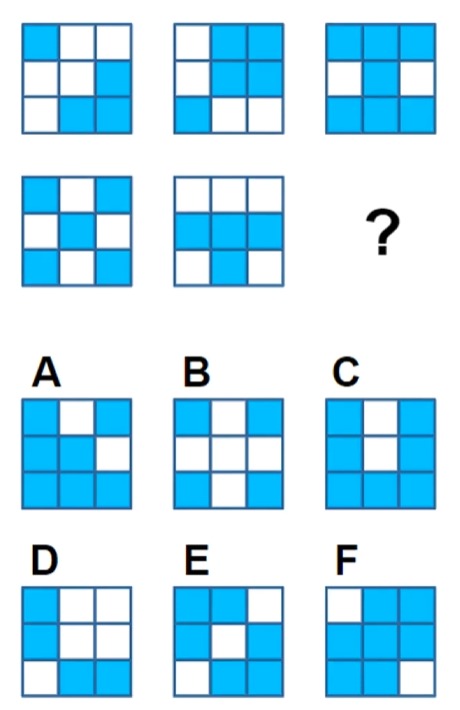
In this puzzle, the third grid in each row is formed by comparing the squares in matching positions in the first two grids.
The rule is simple: if the two squares have different colors, the resulting square is blue. If they have the same color, it is white.
* Blue + white → Blue
* White + blue → Blue
* Blue + blue → White
* White + white → White
This operation is known as “XOR” in logic. A square is blue in the third grid only if it is blue in exactly one of the first two grids.
Checking the Rule in the First Row
The top-left square is blue in the first grid and white in the second. Since the colors are different, it is blue in the third grid.
The center square is white in the first grid and blue in the second. The result is therefore blue again.
The bottom-right square is blue in both grids. Since the colors are the same, it becomes white in the third grid.
Applying this comparison to all nine squares produces the third grid shown in the first row.
Finding the Missing Grid in the Second Row
The first grid has blue squares in all four corners and in the center. The second grid has blue squares across the middle row and in the bottom-middle position.
Comparing these two grids square by square gives:
* Top row: Blue – White – Blue
* Middle row: Blue – White – Blue
* Bottom row: Blue – Blue – Blue
The center square is blue in both grids, so it becomes white. The top-middle square is white in both grids, so it remains white. In every other position, the colors are different, so the resulting square is blue.
The resulting grid matches option C. Therefore, under the intended rule, the correct answer is C.