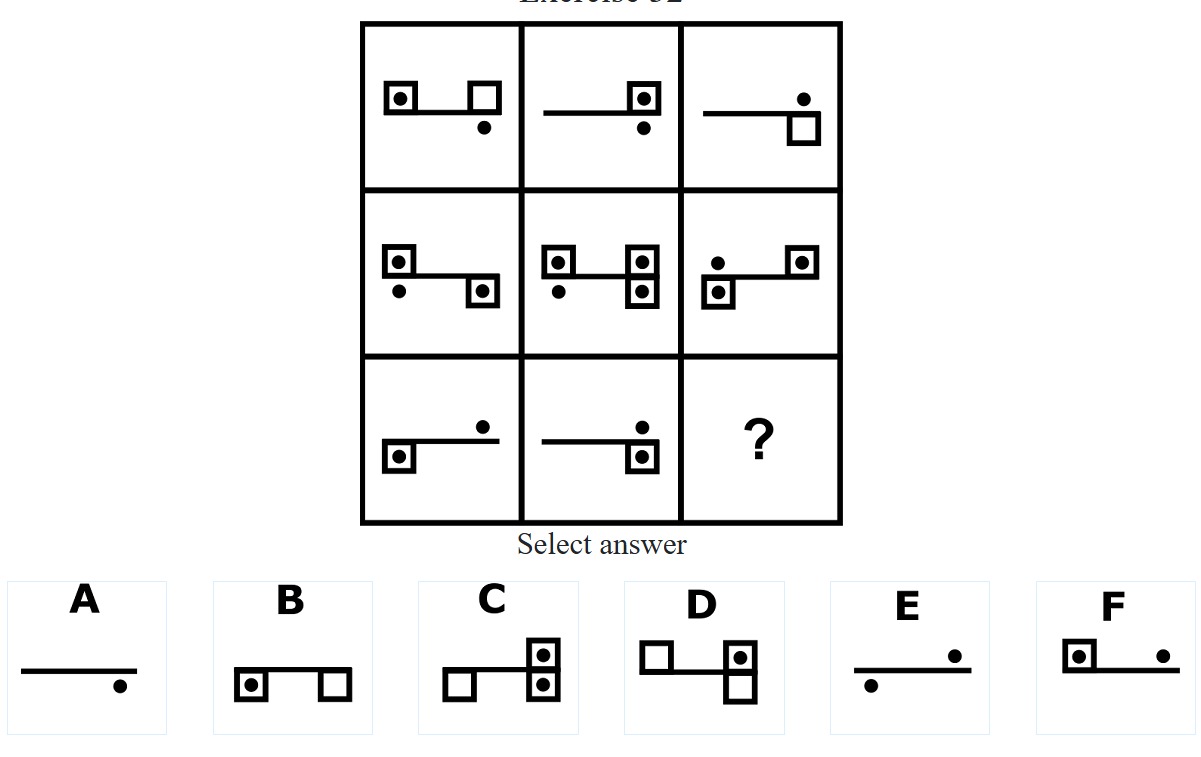
Explanation
fSOLITION-1
From the reddit community @d00meriksen
"I I finally got it. The answer is A.
1. Each cell has 4 positions (top left, top right, bottom left, bottom right).
2. Each position can have nothing, a dot, a square or both in it
3. This puzzle can be solved top to bottom or left to right. This means all cells in the third column as well as in the third row can be calculated with the following algorithm:
4. Go through cell 3's positions one by one. Check the same position on the two previous cells. If both have a square there, copy it to that position into cell 3, but flip "top" and "bottom".
5. Repeat the above for dots as well.
(1,3)[top left] and (2,3)[top left] do not share a square nor a dot, so (3,3)[bottom left] is empty
(1,3)[top right] and (2,3)[top right] share a dot, so copy it to (3,3)[bottom right]
(1,3)[bottom left] and (2,3)[bottom left] do not share a square nor a dot, so (3,3)[top left] is empty
(1,3)[bottom right] and (2,3)[bottom right] do not share a square nor a dot, so (3,3)[top right] is empty"
SOLITION -2
From the reddit community @ContanLand4812
"I believe the answer is A because it appears the third box of each row obtains the right side of the drawing by reflecting the right side of the drawing in the first box of the row over the horizontal line, and similarly the third box also obtains the left side of the drawing by reflecting the left side of the drawing in the second box of the row over the horizontal line.
for example in the first box to the left of row 1, we see that the right side of the drawing is an empty box over a solid circle. in the third box of the first row the right side of the drawing is a solid circle over an empty box. in this same way we can see that the left side of box 2 of row 1 has left side nothing over nothing, which reflected over the horizontal line is still nothing over nothing, as we see in the third box.
you can use the same process in row 2 to confirm this is the pattern (or at least one logical observable pattern) and apply the process to row 3 to find out that answer A matches perfectly. to be honest i just found this answer by playing around with reflections because the horizontal line gave me the idea that it could act as an axis to be reflected across."