Smooth Pursuit

Tracking - Smooth Pursuit

Brain training: keep your cursor inside a moving circle. Smooth pursuit and motor control.

Tracking

About this exercise

Tracking measures smooth pursuit - the ability to predict and follow a moving target with your hand.

A circle traces a complex path across the field. Your job: keep your cursor (or finger) inside it for as much of the duration as possible.

Reactive chasing fails - by the time you react, the target has moved. The skill is anticipating the path and leading the target.

Smooth pursuit is one of the cleanest measures of cerebellar and prefrontal coordination; it declines early in many neurological conditions.

The science

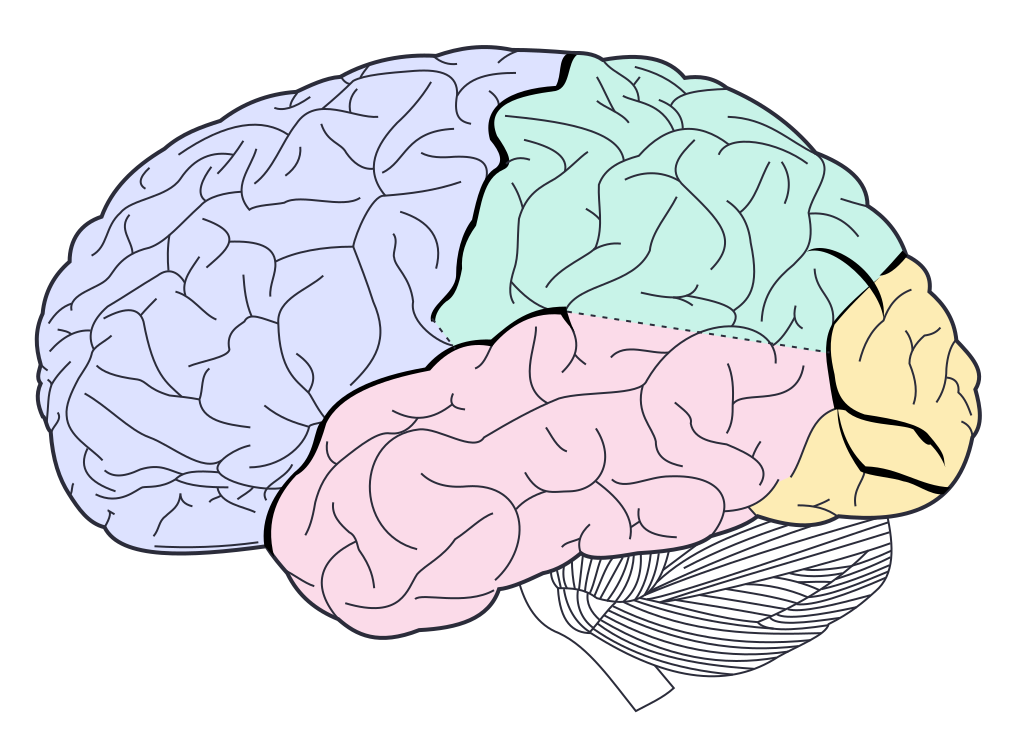
Smooth pursuit eye movements use the same predictive circuitry as motor tracking - frontal eye field, MT/MST, and cerebellum.

Tracking accuracy correlates with sport performance, driving safety, and reading fluency in distinct studies.

What it measures

Your ability to hold continuous visual focus and steer with it.

Tracking taps sustained visuomotor attention: keeping a cursor inside a moving target demands continuous prediction of where the target is heading and constant fine motor correction. Unlike discrete-response tasks, there is no pause between trials, so the score reflects how steadily you can maintain focus and smooth control over an unbroken stretch of time.

This pursuit demand differs from reaction-time tasks, which measure single bursts of speed. Here the challenge is stability rather than speed, closer to the skill of keeping a vehicle in lane or following a moving subject with a camera, where lapses show up as drift rather than a single missed response.

How to train it effectively

Anticipate the target path rather than chasing where it just was.

Begin at a slower target speed and prioritise staying inside the circle over catching up after a slip. As control becomes smooth, raise the speed gradually. Train your eyes to lead slightly ahead of the target so your hand corrects proactively, which keeps you centred instead of perpetually lagging behind the motion.

The usual mistake is reacting to the target position you already see, which guarantees you trail it; pursuit works best when you predict the trajectory. Over-gripping and jerky corrections also hurt, since they overshoot. Relaxed, continuous micro-adjustments outperform tense, large ones, and brief sessions avoid the fatigue that breaks smooth pursuit.

Interpreting your score

Time-on-target matters more than any single good stretch.

Your result is essentially the proportion of time you keep the cursor on the target, so read it as sustained control rather than peak skill. Strong performers hold a high percentage even as speed rises. Watch whether your time-on-target trends upward at a fixed difficulty before increasing speed, which shows genuine control gains.

Pursuit is sensitive to fatigue, caffeine, and even input device, so compare sessions under similar conditions. A high score reflects visuomotor control on this specific task; it does not measure memory, reasoning, or attention to discrete events, which rely on different processes than continuous tracking.

How to play

  1. A circle moves in a continuous path.
  2. Keep your cursor or finger inside the circle.
  3. Anticipate the path - don't chase reactively.
  4. Score = percentage of time on target.