Sustained Reactive

Whack-a-Mole - Sustained Reactive

Tap the moles before they hide. Sustained reactive attention in a grid.

Whack-a-Mole

About this exercise

Whack-a-Mole trains sustained reactive attention with the classic grid paradigm.

Moles pop up in random grid cells and disappear quickly. You must spot and tap each before it hides.

Empty-cell taps incur a misclick penalty, so you cannot just spam-tap the grid. Precision matters.

The fixed grid layout differs from free-position games - it trains efficient grid scanning rather than wide attentional sweep.

The science

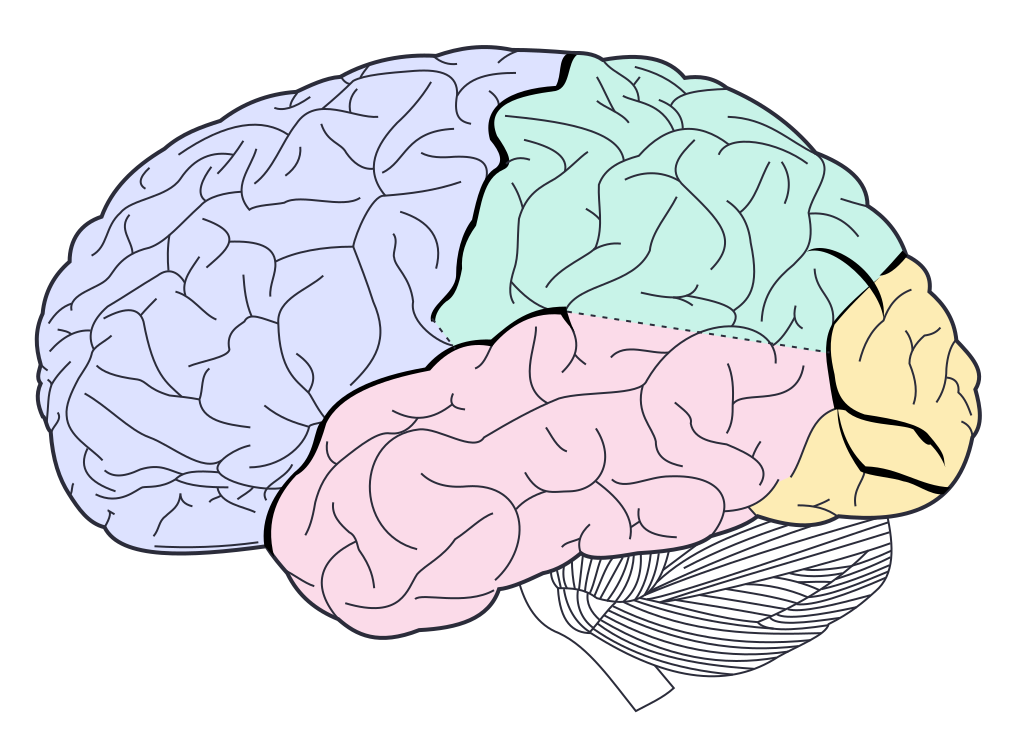
Whack-a-Mole-style tasks load the fronto-parietal attention network and the cerebellum for rapid motor selection.

A staple of preschool attention research, the paradigm scales smoothly to adult use by tightening hide times.

What it measures

It gauges how fast you can find an unpredictable target and act on it.

This task isolates the loop between covert spatial orienting and a triggered motor response. Because moles appear at unpredictable cells, there is no useful cue to pre-position attention, so each trial measures the time to detect onset, localize it across the grid, and program a tap. A strong result reflects efficient, repeatable detect-localize-act cycles, not raw finger speed.

Unlike a simple reaction-time test with one fixed button, the spatial uncertainty here adds a visual-search and pointing component, so distance and grid size matter. It resembles the demands of goalkeeping, fast ball sports, or scanning a dashboard for the one indicator that just lit, where the target's location is genuinely unknown until it appears.

How to train it effectively

Build a stable scan first, then push speed and grid size gradually.

Start on a small grid at a generous pop-up duration and keep your gaze centred so peripheral vision catches onsets anywhere. Aim for accuracy over speed until you rarely miss, then shorten the visible window or enlarge the grid by one step. Level up only when your hit rate holds across a full session, not after a single lucky streak.

The common trap is fixating on the spot a mole just appeared, which leaves you blind to the next one elsewhere. Resist hovering your hand over recent locations, since onsets are random and prior position carries no information. Keep a soft, central fixation and let movement pull your attention, rather than hunting cell by cell.

Interpreting your score

Read your own trend across sessions, not any single number.

Your score blends hit rate with how quickly you tap after each mole appears, both shaped by grid size and pop-up duration. Compare only runs at the same settings. Typical progress shows hit rate climbing first, then average response time falling. A consistently high hit rate with steady, fast taps is strong; erratic times signal lapses in vigilance.

The number is highly state-dependent: fatigue, caffeine, screen lag, and input device all shift it, so one low session is not a verdict. A good score reflects practised detect-and-tap on this grid, not general intelligence, memory, or attention in noisy real-world settings, and gains here may not transfer to unrelated tasks.

How to play

  1. Moles pop up briefly in random grid cells.
  2. Tap each mole before it hides.
  3. Tapping empty holes counts as a misclick.
  4. Use peripheral vision - fixate the grid center.