Introduction to Working Memory and IQ
Working memory is the brain's mental workspace - the system that holds and manipulates information in real time while you think, reason, and solve problems. It is one of the strongest predictors of IQ and overall cognitive ability, yet most people have never heard of it.
"Working memory is the foundation upon which all higher cognitive functions are built."
- Dr. Torkel Klingberg, neuroscientist and author of The Overflowing Brain
Unlike long-term memory, which stores facts and experiences indefinitely, working memory is temporary and capacity-limited. You use it every time you do mental arithmetic, follow a conversation, or hold a phone number in your head while searching for a pen. The question that researchers have pursued for decades is simple but profound: can training this mental workspace actually raise your IQ?
The answer, as we will explore in this article, is nuanced. Targeted working memory training - especially under time pressure - can produce measurable cognitive gains. But not all training is created equal, and understanding the science is essential before you begin.
If you want to benchmark your current abilities before diving in, take our full IQ test or try a timed IQ test to see where you stand.
What Is Working Memory and How Does It Relate to IQ?
Working memory is a cognitive system responsible for temporarily holding and manipulating information needed for complex tasks such as learning, reasoning, and comprehension. Think of it as a mental scratchpad with limited space - you can juggle only a few pieces of information at a time before something gets dropped.
The Three Components of Working Memory
The most widely accepted model, proposed by Alan Baddeley and Graham Hitch in 1974, breaks working memory into three components:
| Component | Function | Example |
|---|---|---|
| Phonological Loop | Holds verbal and acoustic information | Repeating a phone number in your head |
| Visuospatial Sketchpad | Manages visual and spatial data | Mentally rotating a 3D object |
| Central Executive | Directs attention and coordinates the other systems | Switching between tasks during a meeting |
Baddeley later added a fourth component, the episodic buffer, which integrates information across domains and links working memory to long-term memory.
Why Working Memory Predicts IQ
The relationship between working memory and IQ is one of the most robust findings in cognitive psychology. Research by Andrew Conway and colleagues (2003) demonstrated that working memory capacity accounts for a substantial portion of variance in fluid intelligence - the ability to solve novel problems without relying on prior knowledge.
"The correlation between working memory capacity and fluid intelligence is among the highest in all of differential psychology."
- Dr. Randall Engle, Georgia Institute of Technology
This connection exists because IQ tests - especially those measuring fluid intelligence like Raven's Progressive Matrices - require you to hold multiple rules, patterns, and relationships in mind simultaneously. That is exactly what working memory does.
| Cognitive Measure | Correlation with Working Memory | Source |
|---|---|---|
| Fluid Intelligence (Gf) | r = 0.60 - 0.80 | Engle et al., 1999 |
| Reading Comprehension | r = 0.45 - 0.65 | Daneman & Carpenter, 1980 |
| Mathematical Reasoning | r = 0.50 - 0.70 | Bull & Scerif, 2001 |
| Processing Speed | r = 0.30 - 0.50 | Fry & Hale, 1996 |
However, IQ is multifaceted. Working memory is a powerful predictor, but it is not the whole story. Crystallized intelligence (accumulated knowledge), processing speed, and other factors also play important roles.
To test how your working memory performs under real assessment conditions, try our practice IQ test designed to challenge multiple cognitive domains.
How Does Time Pressure Affect Working Memory Performance?
Time pressure fundamentally changes how working memory operates. When the clock is ticking, your brain must process information faster, make decisions quicker, and manage cognitive resources more efficiently. This creates both challenges and opportunities for training.
The Yerkes-Dodson Law: Finding the Sweet Spot
In 1908, psychologists Robert Yerkes and John Dodson discovered a principle that remains central to cognitive performance today: there is an optimal level of arousal for peak performance. Too little pressure leads to boredom and disengagement; too much leads to anxiety and cognitive breakdown.
"The relationship between arousal and performance forms an inverted U - moderate stress enhances cognition, while extreme stress destroys it."
- Yerkes-Dodson Law (1908)
For working memory specifically, moderate time pressure can:
- Sharpen focus by filtering out irrelevant distractions
- Increase processing speed by forcing more efficient neural pathways
- Build cognitive resilience through repeated exposure to demanding conditions
But excessive time pressure overwhelms the system. Cognitive load theory, developed by John Sweller in the late 1980s, explains why: working memory has a finite capacity (roughly 4 +/- 1 items according to Cowan's 2001 research), and when demands exceed that capacity, performance collapses.
Real-World Example: Chess Under Time Pressure
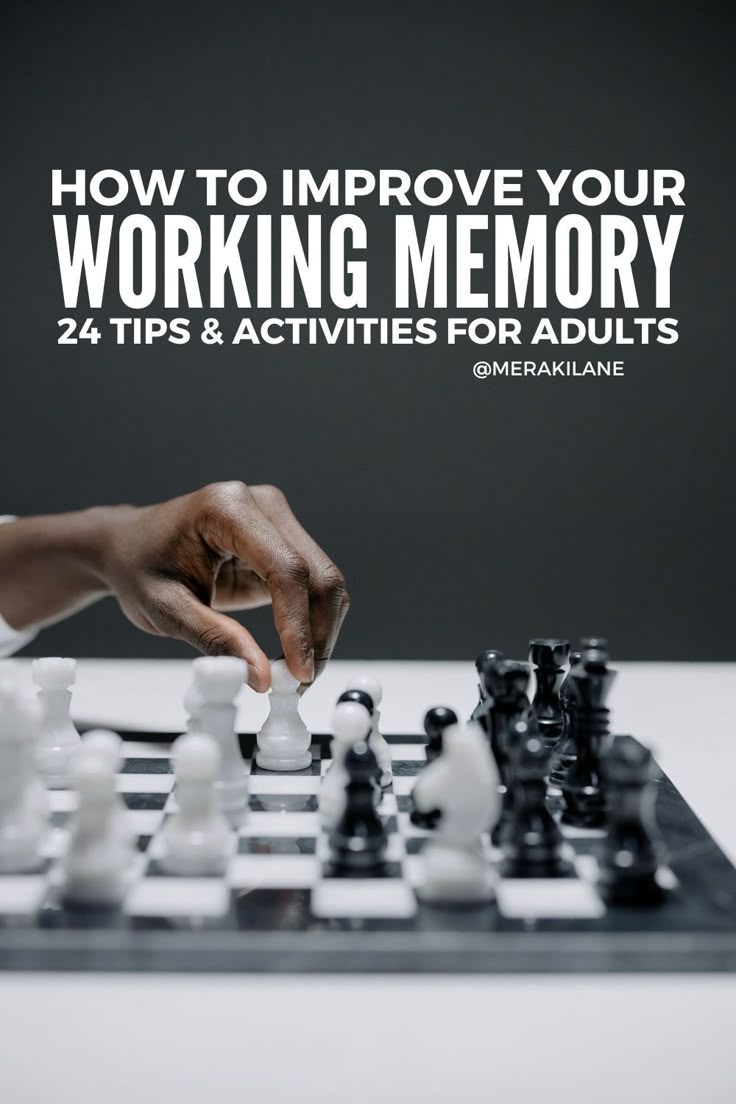
Consider blitz chess, where each player has only 3-5 minutes for the entire game. Grandmasters like Magnus Carlsen demonstrate extraordinary working memory under extreme time pressure - holding board positions, calculating variations, and executing strategies simultaneously. But even elite players make more errors in blitz than in classical chess, illustrating the cost of time constraints.
This is why training progressively under time pressure is so effective: it gradually expands your capacity to perform under real-world conditions without triggering cognitive overload.
Incorporating timed exercises, such as our timed IQ test, into your training regimen simulates these conditions and helps you build cognitive resilience.
What Are Effective Strategies for Working Memory Training?
Not all brain training is created equal. The scientific literature has identified several evidence-based approaches that genuinely improve working memory capacity, while debunking others as ineffective.
The Top 5 Evidence-Based Training Methods
| Method | How It Works | Evidence Level |
|---|---|---|
| Dual N-Back | Track two stimulus streams simultaneously; identify matches N steps back | Strong (Jaeggi et al., 2008) |
| Complex Span Tasks | Remember items while performing a secondary processing task | Strong (Conway et al., 2005) |
| Adaptive Difficulty Training | Difficulty adjusts automatically based on your performance | Moderate-Strong |
| Interleaved Practice | Mix different types of cognitive tasks in a single session | Moderate |
| Mindfulness + WM Training | Combine focused attention meditation with memory exercises | Emerging |
The Dual N-Back: Gold Standard of WM Training
The dual n-back task gained widespread attention after a landmark 2008 study by Susanne Jaeggi and colleagues at the University of Michigan. Participants who trained on the dual n-back task for 8-19 days showed significant improvements in fluid intelligence - a finding that challenged the long-held belief that fluid intelligence was fixed.
"We provide evidence that training on a demanding working memory task can improve fluid intelligence, a finding that has broad implications for education and cognitive development."
- Jaeggi, Buschkuegl, Jonides, & Perrig (2008), Proceedings of the National Academy of Sciences
In this task, you simultaneously track:
- Visual positions - a square appears in different locations on a grid
- Audio stimuli - letters are spoken aloud
You must identify when either stimulus matches the one presented N steps earlier. As you improve, N increases, pushing your working memory capacity further.
Key Principles for Effective Training
- Consistency over intensity: 20-30 minutes per day, 4-5 days per week produces better results than marathon sessions
- Progressive overload: Like physical exercise, the difficulty must increase as you adapt
- Transfer focus: Choose tasks that engage multiple working memory components, not just one
- Active engagement: Passive brain games (word searches, simple puzzles) do not meaningfully improve working memory
Common Misconception: Apps like Lumosity or simple Sudoku puzzles can dramatically boost IQ. Research by Adrian Owen and colleagues (2010) - involving over 11,000 participants - found that general brain training games improved performance on the trained tasks but showed no transfer to broader cognitive abilities. Only targeted working memory training shows meaningful transfer.
For a practical starting point, try our practice IQ test to identify your baseline, then build a training routine around the methods above.
How Can Working Memory Be Trained Effectively Under Time Pressure?
Training working memory under time pressure requires a deliberate, progressive approach that respects the brain's capacity limits while systematically expanding them. Here is a structured framework:
The 4-Phase Time Pressure Training Protocol
Phase 1: Untimed Mastery (Weeks 1-2) Build accuracy and confidence without any clock. Focus on understanding the task demands and developing reliable strategies.
Phase 2: Generous Time Limits (Weeks 3-4) Introduce time constraints that allow completion with moderate effort. The goal is to maintain accuracy while beginning to develop speed.
Phase 3: Progressive Compression (Weeks 5-8) Gradually reduce time limits by 10-15% each week. This forces faster retrieval and manipulation of information, encouraging automaticity - the ability to perform cognitive operations with minimal conscious effort.
Phase 4: Performance Testing (Ongoing) Alternate between timed and untimed assessments to track both speed and accuracy gains. This prevents frustration and provides a comprehensive picture of improvement.
Practical Exercises for Each Phase
| Phase | Exercise | Time Limit | Goal |
|---|---|---|---|
| 1 | Digit span forward/backward | None | Establish baseline accuracy |
| 2 | Mental arithmetic chains | 60 seconds per problem | Maintain 85%+ accuracy |
| 3 | Dual n-back with timer | Reduce by 10% weekly | Build processing speed |
| 4 | Full cognitive assessment | Standard test conditions | Measure transfer |
The Pomodoro Approach to Cognitive Training
Francesco Cirillo's Pomodoro Technique can be adapted for working memory training:
- 25 minutes of focused, timed cognitive exercises
- 5-minute break (complete mental rest - no screens, no problem-solving)
- Repeat 3-4 cycles
- 20-minute extended break after the final cycle
This structure prevents cognitive fatigue while maximizing training density.
Important: Training under excessive time pressure without adequate skill development leads to what psychologists call choking under pressure - a phenomenon studied extensively by Sian Beilock at the University of Chicago. Her research shows that anxiety consumes working memory resources, creating a vicious cycle of poor performance and increased stress.
For periodic progress checks, take a timed IQ test alongside an untimed full IQ test to see how your speed and accuracy are developing independently.
What Are the Practical Benefits of Improving Working Memory?
The benefits of enhanced working memory extend far beyond IQ test scores. Research across education, professional performance, and healthy aging reveals significant real-world advantages.
Academic Performance
A longitudinal study by Tracy Alloway and Ross Alloway (2010) found that working memory at age 5 was a stronger predictor of academic success than IQ. Children with higher working memory capacity performed better in reading, mathematics, and science - even after controlling for IQ and socioeconomic status.
"Working memory is more important than IQ for predicting academic achievement in the early school years."
- Dr. Tracy Alloway, University of North Florida
Professional Performance
In the workplace, working memory underpins critical capabilities:
- Surgeons rely on working memory to track multiple patient variables during complex procedures
- Air traffic controllers must hold and update the positions, speeds, and altitudes of dozens of aircraft simultaneously
- Software engineers use working memory to maintain mental models of code architecture while debugging
- Financial analysts juggle multiple data points and market variables to make real-time decisions
Cognitive Health and Aging
Research from the ACTIVE trial (Advanced Cognitive Training for Independent and Vital Elderly) - one of the largest cognitive training studies ever conducted - demonstrated that targeted training can produce cognitive benefits lasting up to 10 years. Participants who trained on processing speed and memory tasks showed reduced rates of cognitive decline compared to control groups.
| Benefit | Evidence | Impact |
|---|---|---|
| Better academic grades | Alloway & Alloway, 2010 | Stronger predictor than IQ alone |
| Improved professional decision-making | Multiple workplace studies | Fewer errors under pressure |
| Delayed cognitive decline | ACTIVE Trial, 2014 | Benefits persist 10+ years |
| Enhanced emotional regulation | Schweizer et al., 2013 | Better stress management |
| Greater learning speed | Gathercole et al., 2004 | Faster acquisition of new skills |
To explore your current cognitive strengths, start with our quick IQ assessment and progress to the full IQ test for a comprehensive evaluation.
How Do Different Types of IQ Tests Measure Working Memory?
Understanding how working memory is measured helps you choose the right assessment and training approach. Different IQ tests emphasize different aspects of working memory.
Standardized IQ Tests and Working Memory Subtests
| IQ Test | Working Memory Subtests | What They Measure |
|---|---|---|
| WAIS-IV (Wechsler Adult Intelligence Scale) | Digit Span, Arithmetic, Letter-Number Sequencing | Verbal working memory, mental manipulation |
| Stanford-Binet 5 | Block Span, Memory for Sentences | Visual and verbal working memory |
| Raven's Progressive Matrices | Pattern completion (implicit WM demands) | Fluid intelligence via working memory |
| Cattell Culture Fair Test | Series completion, matrices | Non-verbal working memory |
Timed vs. Untimed Assessments
The choice between timed and untimed tests reveals different aspects of working memory:
- Timed tests measure processing efficiency - how quickly and accurately you can deploy working memory resources under pressure. They correlate more strongly with real-world performance under demanding conditions.
- Untimed tests measure capacity - the maximum amount of information you can hold and manipulate when speed is not a factor. They better reflect potential when environmental stressors are removed.
"Speed and accuracy in cognitive tasks reflect different underlying mechanisms. A complete assessment of working memory requires measuring both."
- Dr. Nelson Cowan, University of Missouri, leading working memory researcher
Albert Einstein reportedly performed poorly on timed tests in school but excelled in deep, untimed reasoning - a reminder that working memory capacity and processing speed are related but distinct constructs. The ideal training program addresses both.
Try our practice test for skill-building in a low-pressure environment, or the timed IQ test to challenge yourself under real time constraints.
What Are Common Misconceptions About Working Memory and IQ Training?
The field of cognitive training is rife with exaggerated claims and misunderstandings. Here are the most common myths, corrected by current research:
Myth vs. Reality
| Myth | Reality | Source |
|---|---|---|
| Working memory capacity is fixed at birth | WM can be improved through targeted training, though gains vary | Klingberg et al., 2005 |
| All brain training apps work equally well | Only adaptive, challenging programs targeting core WM processes show transfer | Owen et al., 2010 |
| More time pressure always means better training | Excessive pressure causes anxiety and impairs learning | Beilock, 2010 |
| 10 minutes of daily brain games raises IQ | Meaningful gains require 20-30 min/day of structured, adaptive training | Jaeggi et al., 2011 |
| IQ is entirely genetic and cannot change | While genetics play a role (50-80%), environment and training matter significantly | Nisbett et al., 2012 |
The Lumosity Lawsuit: A Cautionary Tale
In 2016, the Federal Trade Commission fined Lumos Labs (makers of Lumosity) $2 million for deceptive advertising. The company had claimed their games could improve general cognitive abilities, delay age-related decline, and even help with conditions like ADHD - claims not supported by their own research.
"Lumosity preyed on consumers' fears about age-related cognitive decline, suggesting their games could stave off memory loss, dementia, and even Alzheimer's disease. But Lumosity simply did not have the science to back up its ads."
- Jessica Rich, Director of the FTC's Bureau of Consumer Protection
This does not mean all cognitive training is useless. It means you must distinguish between scientifically validated approaches (like dual n-back and adaptive working memory training) and commercially marketed games with little evidence behind them.
What Actually Works: The Scientific Consensus
Leading researchers including Torkel Klingberg, Susanne Jaeggi, and Randall Engle generally agree on several points:
- Working memory can be trained, but improvements are task-specific unless training is sufficiently challenging and adaptive
- Transfer to fluid intelligence is possible but not guaranteed - it depends on training intensity, duration, and individual differences
- Consistency matters more than intensity - regular, moderate training outperforms sporadic, intensive sessions
- Motivation and engagement are critical - forced or boring training produces minimal gains
For genuine assessment and training, start with our quick IQ assessment and gradually progress to the full IQ test or timed IQ test.
Conclusion: Harnessing Working Memory Training to Boost IQ Under Time Constraints
The science is clear: working memory is one of the most important cognitive abilities underlying intelligence, and it can be improved through deliberate, structured training. The key is to approach it like any serious skill development - with patience, consistency, and a commitment to evidence-based methods.
Your Action Plan
- Assess your baseline - Take a full IQ test or practice test to understand your current abilities
- Start with untimed training - Build accuracy and confidence with dual n-back and complex span tasks
- Progressively add time pressure - Use the 4-phase protocol outlined above
- Train consistently - 20-30 minutes per day, 4-5 times per week
- Reassess periodically - Take a timed IQ test every 4-6 weeks to track progress
- Stay skeptical - Avoid programs making extraordinary claims without scientific backing
"Intelligence is not fixed. The brain is plastic, and with the right kind of training, cognitive abilities can be meaningfully enhanced."
- Dr. Richard Nisbett, University of Michigan, author of Intelligence and How to Get It
The journey to enhanced cognitive performance is not a sprint - it is a marathon. But the evidence shows that with the right approach, meaningful and lasting improvements in working memory and IQ are within reach.
Frequently Asked Questions
Can working memory training improve IQ scores significantly?
Working memory training can produce measurable improvements in fluid intelligence, with studies reporting gains of 3-5 IQ points after several weeks of consistent training. The landmark study by Jaeggi et al. (2008) demonstrated that dual n-back training transferred to improved fluid intelligence scores. However, IQ is multifaceted, and working memory is just one contributing factor.
The most substantial gains come from combining working memory training with other evidence-based cognitive exercises over an extended period.
How often should I practice working memory exercises under time pressure?
For optimal results, aim for 4-5 sessions per week, each lasting 20-30 minutes. Research by Klingberg et al. (2005) found that 5 weeks of daily adaptive training produced significant working memory improvements. Start with untimed exercises for the first 1-2 weeks, then progressively introduce and tighten time constraints.
Always balance training days with rest days to allow for neural consolidation - the process by which the brain strengthens new cognitive pathways during rest and sleep.
Are there risks associated with excessive cognitive training under time pressure?
Yes. Excessive training under intense time pressure can lead to cognitive fatigue, anxiety, and burnout. Research by Sian Beilock (2010) at the University of Chicago demonstrates that performance anxiety consumes working memory resources, creating a paradoxical decline in the very abilities you are trying to improve.
Signs of overtraining include persistent frustration, declining performance despite effort, and difficulty concentrating outside of training sessions. The solution is to maintain a balanced approach: alternate timed and untimed practice, take regular breaks, and reduce intensity if you notice diminishing returns.
How do I know if my working memory has improved through training?
Track your progress using multiple metrics: accuracy on training tasks, response time under timed conditions, and performance on standardized assessments. Take our practice test or timed IQ test every 4-6 weeks to get objective benchmarks. Look for improvements in both *speed* (faster correct responses) and *capacity* (ability to handle more complex problems).
Real-world indicators include better concentration during work or study, improved ability to follow complex conversations, and reduced mental fatigue during demanding tasks.
Is working memory training effective for all age groups?
Yes, research supports working memory training benefits across the lifespan. Children (ages 7-12) show some of the fastest gains due to high neural plasticity, with Klingberg's research demonstrating improvements in both working memory and attention in children with ADHD. Young adults (18-35) benefit most from intensive, adaptive training programs.
Older adults (60+) can improve working memory capacity and potentially delay age-related cognitive decline, as demonstrated by the ACTIVE trial. The key principle across all age groups is adaptive difficulty - the training must continuously challenge you at the edge of your current ability.
References
- Alloway, T. P., & Alloway, R. G. (2010). Investigating the predictive roles of working memory and IQ in academic attainment.*Journal of Experimental Child Psychology*, 106(1), 20-29. - Baddeley, A. D., & Hitch, G. (1974). Working memory. In G. H. Bower (Ed.), *The Psychology of Learning and Motivation* (Vol. 8, pp. 47-89). Academic Press. - Beilock, S. L. (2010). *Choke: What the Secrets of the Brain Reveal About Getting It Right When You Have To*. Free Press. - Conway, A. R. A., Kane, M. J., & Engle, R. W. (2003). Working memory capacity and its relation to general intelligence.
*Trends in Cognitive Sciences*, 7(12), 547-552. - Cowan, N. (2001). The magical number 4 in short-term memory: A reconsideration of mental storage capacity. *Behavioral and Brain Sciences*, 24(1), 87-114. - Jaeggi, S. M., Buschkuegl, M., Jonides, J., & Perrig, W. J. (2008). Improving fluid intelligence with training on working memory. *Proceedings of the National Academy of Sciences*, 105(19), 6829-6833. - Klingberg, T. (2009).
*The Overflowing Brain: Information Overload and the Limits of Working Memory*. Oxford University Press. - Klingberg, T., Fernell, E., Olesen, P. J., et al. (2005). Computerized training of working memory in children with ADHD. *Journal of the American Academy of Child & Adolescent Psychiatry*, 44(2), 177-186. - Nisbett, R. E., Aronson, J., Blair, C., et al. (2012). Intelligence: New findings and theoretical developments. *American Psychologist*, 67(2), 130-159.
- Owen, A. M., Hampshire, A., Grahn, J. A., et al. (2010). Putting brain training to the test. *Nature*, 465(7299), 775-778. - Rebok, G. W., Ball, K., Guey, L. T., et al. (2014). Ten-year effects of the ACTIVE cognitive training trial on cognition and everyday functioning in older adults. *Journal of the American Geriatrics Society*, 62(1), 16-24.
Related Articles


Curious about your IQ?
You can take a free online IQ test and get instant results.
Take IQ Test