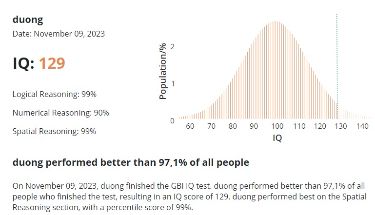
Quick Answer: A "good" IQ score depends on context, but scores of 110 and above are considered above average, placing you in roughly the 75th percentile or higher. The average IQ is 100 (50th percentile), and the gifted threshold begins at 130 (98th percentile). However, IQ is just one measure of cognitive ability - percentile rankings provide a far clearer picture of where you stand relative to the general population.
You took an IQ test. You received a number. Now what?
For most people, the raw score - whether it is 95, 112, or 134 - feels abstract. Is 112 good? Is 95 something to worry about? What does 134 actually mean in practical terms? The answer to all of these questions lies in understanding IQ percentiles: the statistical framework that transforms a raw number into a meaningful comparison against the rest of the population.
This guide will walk you through exactly how IQ scores are distributed, what the major classification systems say about different score ranges, and - critically - what your score does and does not tell you about your cognitive abilities.
"The important thing about any IQ score is not the number itself, but what that number means in comparison to a well-defined reference group."
- Kaufman, A. S. (2009), IQ Testing 101
How IQ Scores Are Distributed: The Bell Curve
IQ scores follow a normal distribution (bell curve), a mathematical pattern where most values cluster around the center and fewer values appear at the extremes. For IQ:
- Mean (average): 100
- Standard deviation (SD): 15
- Shape: Symmetrical - the same percentage of people score above 100 as below it
This distribution is not accidental. IQ tests are deliberately designed to produce this pattern through a process called norming, in which test developers administer the test to thousands of people and then calibrate scoring so that the results fit the bell curve.
What the Standard Deviation Tells You
The standard deviation of 15 is the key to understanding every IQ score. Each SD away from the mean represents a specific percentile:
| Distance from Mean | IQ Score | Percentile | Proportion of Population |
|---|---|---|---|
| -3 SD | 55 | 0.1st | 1 in 1,000 |
| -2 SD | 70 | 2.3rd | 1 in 44 |
| -1 SD | 85 | 15.9th | 1 in 6 |
| Mean | 100 | 50th | 1 in 2 |
| +1 SD | 115 | 84.1st | 1 in 6 |
| +2 SD | 130 | 97.7th | 1 in 44 |
| +3 SD | 145 | 99.9th | 1 in 1,000 |
This means that an IQ of 115 - which might feel only slightly above average - actually places you ahead of 84 out of 100 people. Conversely, the jump from 130 to 145 represents a move from the top 2.3% to the top 0.1%, an enormous gap in rarity despite being "only" 15 points.
"People routinely underestimate how much a single standard deviation means. Moving from 100 to 115 puts you ahead of five out of six people in the room."
- Gottfredson, L. S. (1997), Mainstream Science on Intelligence
IQ Score Ranges: Complete Classification Table
Different IQ test publishers use slightly different classification labels. The table below compares the three most widely referenced systems:
| IQ Range | Wechsler Classification | Stanford-Binet Classification | Percentile Range | Rarity |
|---|---|---|---|---|
| 145+ | Very Superior | Very Gifted or Highly Advanced | 99.9th+ | ~1 in 1,000 |
| 130-144 | Very Superior | Gifted or Very Advanced | 97.7th-99.8th | ~1 in 44 |
| 120-129 | Superior | Superior | 90.9th-97.6th | ~1 in 11 |
| 110-119 | High Average | High Average | 74.2nd-90.8th | ~1 in 4 |
| 90-109 | Average | Average | 25.2nd-74.1st | ~1 in 2 |
| 80-89 | Low Average | Low Average | 9.2nd-25.1st | ~1 in 4 |
| 70-79 | Borderline | Borderline Impaired or Delayed | 2.3rd-9.1st | ~1 in 11 |
| Below 70 | Extremely Low | Impaired or Delayed | Below 2.3rd | ~1 in 44 |
What Do These Categories Mean in Practice?
The bands describe where a score sits in the population. Average (90 to 109) is the literal center where most people fall; High Average (110 to 119) puts a 115 ahead of about 84 percent of people; Superior (120 to 129) indicates strong ability common among professionals and graduate students. Each band is a range, not a hard cutoff.
- Average (90-109): This is where the majority of the population falls. Individuals in this range can handle most educational and occupational demands comfortably. An IQ of 100 is exactly average - not below average, not mediocre, but the literal center of the distribution.
- High Average (110-119): Individuals in this range often excel in academic settings and tend to gravitate toward professional careers. A score of 115 places you ahead of approximately 84% of the population.
- Superior (120-129): This range indicates strong cognitive abilities. Many successful professionals, graduate students, and skilled knowledge workers score in this range. A score of 125 places you in roughly the 95th percentile.
- Very Superior / Gifted (130+): The traditional threshold for "giftedness." Only about 2-3% of the population scores here. This is the typical cutoff for Mensa membership and many gifted education programs.
What Is a "Good" IQ Score? It Depends on Context
The question "What is a good IQ score?" does not have a single answer because "good" depends entirely on what you are measuring against:
| Context | "Good" IQ Threshold | Why |
|---|---|---|
| General population | 100+ (above average) | You outperform more than half the population |
| College admission (typical) | 110+ | Correlated with successful completion of a 4-year degree |
| Competitive graduate programs | 120+ | Many top MBA, law, and medical programs draw from this range |
| Gifted program eligibility | 130+ | Standard cutoff used by most school districts |
| Mensa membership | 130+ (98th percentile) | Requires scoring in the top 2% on an approved test |
| Profoundly gifted classification | 145+ | Extremely rare; specialized educational needs |
"There is no magic number that separates the intelligent from the unintelligent. Intelligence is a continuum, and where we draw lines is always somewhat arbitrary."
- Neisser, U., et al. (1996), Intelligence: Knowns and Unknowns (APA Task Force Report)
The "Good Enough" Threshold
Research by Gottfredson (2003) suggests that for most everyday tasks - managing finances, understanding health information, following workplace instructions - an IQ of approximately 90-100 is sufficient. Beyond an IQ of about 120, the relationship between IQ and real-world outcomes begins to show diminishing returns: factors like personality, motivation, social skills, and opportunity become increasingly important.
This is sometimes called the threshold hypothesis: IQ matters a great deal up to a certain point, after which other factors dominate.
Detailed IQ-to-Percentile Conversion Table
For precise interpretation, here is a point-by-point conversion for commonly referenced IQ scores:
| IQ Score | Percentile | Meaning | Approximate Rarity |
|---|---|---|---|
| 70 | 2nd | Scores higher than 2% of the population | 1 in 44 |
| 75 | 5th | Scores higher than 5% of the population | 1 in 20 |
| 80 | 9th | Scores higher than 9% of the population | 1 in 11 |
| 85 | 16th | Scores higher than 16% of the population | 1 in 6 |
| 90 | 25th | Scores higher than 25% of the population | 1 in 4 |
| 95 | 37th | Scores higher than 37% of the population | ~1 in 3 |
| 100 | 50th | Scores higher than 50% of the population | 1 in 2 |
| 105 | 63rd | Scores higher than 63% of the population | ~2 in 3 |
| 110 | 75th | Scores higher than 75% of the population | 1 in 4 |
| 115 | 84th | Scores higher than 84% of the population | 1 in 6 |
| 120 | 91st | Scores higher than 91% of the population | 1 in 11 |
| 125 | 95th | Scores higher than 95% of the population | 1 in 20 |
| 130 | 98th | Scores higher than 98% of the population | 1 in 44 |
| 135 | 99th | Scores higher than 99% of the population | 1 in 100 |
| 140 | 99.6th | Scores higher than 99.6% of the population | 1 in 261 |
| 145 | 99.9th | Scores higher than 99.9% of the population | 1 in 1,000 |
| 150 | 99.96th | Scores higher than 99.96% of the population | 1 in 2,330 |
| 155 | 99.99th | Scores higher than 99.99% of the population | 1 in 10,000 |
Notice the asymmetry of rarity: the difference between the 50th and 84th percentile is just 15 IQ points (100 to 115), but reaching the 99.9th percentile from the 98th requires another 15 points (130 to 145). At the extremes, each additional point represents a dramatic increase in rarity.
IQ Scores by Profession: What the Research Shows
One of the most practical ways to contextualize your IQ score is to compare it against the cognitive demands of various occupations. The following data comes from large-scale studies, including those by the U.S. Department of Labor and meta-analyses by Schmidt and Hunter (1998):
| Profession | Estimated Average IQ | Typical Range | Percentile of Average |
|---|---|---|---|
| Physician / Surgeon | 125-130 | 115-145 | 95th-98th |
| Attorney | 120-128 | 110-140 | 91st-97th |
| Engineer | 120-127 | 110-140 | 91st-96th |
| College Professor | 118-125 | 108-140 | 88th-95th |
| Registered Nurse | 110-115 | 100-130 | 75th-84th |
| Skilled Tradesperson | 100-110 | 90-120 | 50th-75th |
| General Office Worker | 100-105 | 85-115 | 50th-63rd |
| Retail / Service Worker | 95-100 | 80-115 | 37th-50th |
These are averages, not requirements. Plenty of successful physicians score below 125, and many people with IQs above 130 work in fields with lower average scores - by choice or circumstance. The table illustrates the cognitive demands of different fields, not a person's worth or potential.
"IQ is a useful predictor, but it is not destiny. The correlation between IQ and job performance, while real, still leaves enormous room for individual variation."
- Schmidt, F. L., & Hunter, J. E. (1998), The Validity and Utility of Selection Methods in Personnel Psychology
Common Misconceptions About IQ Scores and Percentiles
Misconception 1: "My IQ is fixed for life"
Reality: While IQ scores are relatively stable after adolescence (test-retest reliability of r = 0.90+), they are not immutable. A longitudinal study by Ramsden et al. (2011), published in Nature, found that adolescent IQ scores changed by as much as 20 points over a four-year period, with corresponding changes visible on brain imaging. In adults, factors like continued education, cognitive engagement, physical health, and even aerobic exercise can influence scores modestly.
Misconception 2: "A percentile is a percentage of intelligence"
Reality: Being in the 90th percentile does not mean you have "90% of maximum intelligence." It means you scored higher than 90% of the reference population. There is no theoretical maximum for intelligence, and percentiles are relative rankings, not absolute measurements.
Misconception 3: "Small score differences are meaningful"
Reality: The Standard Error of Measurement (SEM) for most IQ tests is approximately 3-5 points. This means a "true" IQ of 110 could produce measured scores anywhere from 105 to 115 across different testing sessions. A difference of 5 points between two people - or between two tests taken by the same person - is generally not statistically significant. Only differences of 10+ points are typically considered meaningful.
| Score Difference | Statistical Significance | Practical Meaning |
|---|---|---|
| 1-4 points | Not significant | Within measurement error; treat as equivalent |
| 5-9 points | Borderline | May reflect real difference; interpret with caution |
| 10-14 points | Likely significant | Meaningful cognitive difference in most domains |
| 15+ points (1 SD) | Highly significant | Clear, observable difference in cognitive performance |
Misconception 4: "Online tests are just as good as professional ones"
Reality: Professional IQ tests (WAIS-IV, Stanford-Binet 5) are normed on samples of 2,000-4,000+ individuals, administered one-on-one by trained psychologists, and have documented reliability and validity. Most online tests lack this rigor. However, a well-designed online assessment can provide a reasonable approximation - useful for curiosity and self-awareness, though not for clinical or legal decisions.
"A test is only as good as its norms. Without a properly representative norming sample, an IQ score is essentially meaningless."
- Kaufman, A. S. (2009), IQ Testing 101
How to Interpret Your IQ Score: A Step-by-Step Guide
If you have received an IQ score and want to understand what it means, follow these steps:
Step 1: Identify your percentile
Use the conversion table above to find your approximate percentile. This tells you what percentage of the population you outperformed.
Step 2: Consider the confidence interval
Your "true" IQ likely falls within a range of plus or minus 5 points from your measured score. A measured IQ of 118, for example, suggests a true IQ somewhere between approximately 113 and 123.
Step 3: Look at subtest scores (if available)
Composite IQ scores can mask significant variation across cognitive domains. A person with an overall IQ of 110 might have:
| Domain | Subtest Score | Percentile | Interpretation |
|---|---|---|---|
| Verbal Comprehension | 125 | 95th | Exceptional language ability |
| Perceptual Reasoning | 115 | 84th | Strong visual-spatial skills |
| Working Memory | 98 | 45th | Average short-term memory |
| Processing Speed | 88 | 21st | Below-average processing speed |
This profile is far more informative than the composite score alone. It reveals specific strengths to leverage and areas where targeted improvement may help.
Step 4: Contextualize against your goals
An IQ of 105 is "average," but that label means very different things depending on whether you are:
- Entering a skilled trade (where 105 is well within the typical range)
- Applying to a competitive law school (where the average student scores 120+)
- Assessing whether a learning difficulty explains academic struggles (where subtest patterns matter more than the composite)
Step 5: Remember the limitations
IQ does not measure motivation, creativity, emotional intelligence, work ethic, or character. These qualities often matter more for long-term success than cognitive ability alone.
If you want to assess your cognitive abilities, you can take our full IQ test for a comprehensive evaluation, try a quick IQ assessment for a faster result, or use a practice IQ test to familiarize yourself with the format.
The Flynn Effect: Why IQ Scores Keep Rising
One of the most striking findings in intelligence research is the Flynn Effect, named after New Zealand researcher James Flynn. Across industrialized nations, average IQ scores have risen approximately 3 points per decade throughout the 20th century (Flynn, 1987).
This means that someone scoring 100 on a test normed in 2020 would have scored approximately 110 on a test normed in 1990 - not because they are smarter in any absolute sense, but because the reference population has shifted.
Proposed explanations for the Flynn Effect include:
- Improved nutrition: Better childhood nutrition supports brain development
- More years of education: Schooling trains the abstract reasoning skills that IQ tests measure
- Environmental complexity: Modern life (technology, media, complex systems) provides more cognitive stimulation
- Reduced infectious disease: Lower disease burden in early childhood frees cognitive resources for development
- Smaller family sizes: More parental attention per child
The Flynn Effect has important implications for percentile interpretation. If you compare your score to old norms, you may overestimate your standing. Always check that your test uses current norms (within the last 10-15 years).
"The IQ gains of the twentieth century are massive - so massive that they force us to reconceive the very meaning of intelligence test scores."
- Flynn, J. R. (2007), What Is Intelligence?
Average IQ by Country: A Global Perspective
National average IQ scores are a contentious topic in psychology. While data from cross-national studies exist (Lynn & Vanhanen, 2002; Rindermann, 2018), they must be interpreted with extreme caution due to differences in test standardization, sampling methods, education systems, and socioeconomic conditions.
That said, the following patterns are broadly observed:
| Region | Estimated Average IQ Range | Key Contributing Factors |
|---|---|---|
| East Asia (Japan, South Korea, China) | 104-108 | High investment in education, strong cultural emphasis on academic achievement |
| Western Europe, North America, Australia | 97-102 | Well-funded education systems, broad access to nutrition and healthcare |
| Eastern Europe | 95-100 | Improving education and health infrastructure |
| Latin America | 85-95 | Variable access to education and healthcare; improving trends |
| South Asia | 82-90 | Rapid improvements correlated with economic development |
| Sub-Saharan Africa | 70-85 | Strongly influenced by nutrition, disease burden, and educational access |
These numbers reflect current environmental conditions, not fixed genetic potential. The Flynn Effect demonstrates that national averages can rise substantially within a single generation when conditions improve. Countries like Kenya and Brazil have shown IQ gains of 10-15 points over recent decades as nutrition, healthcare, and education have expanded.
Putting Your Score in Perspective: Real-World Context
What an IQ of 100 means
You are exactly average. This is not a negative - it means you have the cognitive capacity to handle most everyday tasks, complete a high school education, hold a wide range of jobs, and navigate daily life effectively. Half the population scores below 100.
What an IQ of 115 means
You are in the top 16% of the population. You likely find academic work manageable and may excel in analytical roles. This is roughly the average score for college graduates in many studies.
What an IQ of 130 means
You are in the top 2%. You have the cognitive horsepower for the most demanding academic and professional work. This is the threshold for most gifted programs and Mensa eligibility.
What an IQ of 85 means
You are at the 16th percentile. Academic work may require more effort, but you can absolutely lead a successful, fulfilling life. Many people in this range thrive in hands-on, practical, or creative fields where IQ is less determinative.
Practical Tips for Using Your IQ Results
- Treat your score as a data point, not a label. It is one measurement taken on one day under one set of conditions.
- Pay attention to subtest patterns. A flat profile (all scores similar) is very different from a spiky one (big differences across domains), and the latter may reveal learning disabilities or specific gifts.
- Do not compare casually. Comparing IQ scores between people tested on different instruments, at different ages, or under different conditions is scientifically invalid.
- Use the percentile, not the raw number. Telling someone "you are in the 84th percentile" is more meaningful and less likely to be misinterpreted than saying "your IQ is 115."
- Retest if results seem inconsistent. If your score does not match your real-world functioning, consider retaking the test under better conditions (well-rested, not anxious, professionally administered).
- Focus on what you can control. Education, cognitive engagement, physical fitness, and sleep all have documented effects on cognitive performance.
To get started, you can take our full IQ test, try a timed IQ test that simulates real testing conditions, or use a practice IQ test to prepare.
Frequently Asked Questions
Is an IQ of 120 considered gifted?
An IQ of 120 is classified as "Superior" on the Wechsler scale, placing you in approximately the 91st percentile - meaning you score higher than 91% of the population.
However, the traditional threshold for *giftedness* is an IQ of 130 (98th percentile), which is the standard cutoff used by most school districts, Mensa, and clinical psychologists. A score of 120 indicates strong cognitive abilities and is well above average, but it falls short of the formal gifted classification. Some educational programs use a lower threshold of 120 or 125, so it is worth checking specific program requirements.
Can IQ scores change over time?
Yes. A landmark study by Ramsden et al. (2011) published in *Nature* tracked adolescents over four years and found individual IQ changes of up to 20 points, with corresponding structural changes visible on brain MRI scans.
In adults, changes tend to be smaller (typically 3-7 points), but factors like continued education (Ritchie & Tucker-Drob, 2018 found each year of education adds approximately 1-5 IQ points), physical exercise (particularly aerobic exercise), adequate sleep, and cognitive engagement can all produce measurable improvements. Conversely, chronic stress, substance abuse, and untreated health conditions can lower scores.
How do IQ percentiles differ from raw scores?
Raw scores are the direct count of correct answers on an IQ test. They are meaningless on their own because different tests have different numbers of questions and difficulty levels. Scaled scores convert raw scores to the standardized IQ scale (mean of 100, SD of 15).
Percentiles then translate that scaled score into a ranking: "You scored higher than X% of the population." Percentiles are generally the most useful metric for interpretation because they provide immediate, intuitive context. For example, knowing you are in the "84th percentile" is more informative than knowing your "IQ is 115" without understanding the distribution.
Are IQ tests culturally biased?
This remains an active area of research and debate. Modern IQ tests use statistical techniques like Differential Item Functioning (DIF) analysis to identify and remove items that perform differently across racial, ethnic, or socioeconomic groups. Tests like Raven's Progressive Matrices and Cattell's Culture Fair Intelligence Test were specifically designed to minimize cultural and linguistic loading.
However, no test is perfectly culture-free. The APA's 1996 task force report (*Intelligence: Knowns and Unknowns*) acknowledged that group differences in IQ scores reflect a complex interplay of genetic and environmental factors, including unequal access to education, nutrition, and healthcare - factors that influence test performance without reflecting innate cognitive potential.
What is the difference between average IQ and median IQ?
In a perfectly normal distribution, the mean (average) and the median (middle value) are identical - both are 100.
In real populations, IQ distributions are approximately normal but may show very slight asymmetries. For practical purposes, the average and median IQ in most well-normed populations are effectively the same at 100. The distinction matters more in skewed distributions (e.g., if you tested only university students, the median might be 112 and the mean might be 115 due to a few very high scorers pulling the average up).
How reliable are online IQ tests compared to standardized tests?
Professional tests like the WAIS-IV have test-retest reliability of approximately r = 0.96 and internal consistency above r = 0.97. They are normed on 2,000-4,000+ individuals and administered by licensed psychologists under controlled conditions. Online tests vary enormously in quality. Some are reasonably well-designed and can provide a useful approximation (typically within 5-10 points of a professional result).
Many others are poorly constructed, use outdated norms, or deliberately inflate scores to encourage sharing. For clinical, educational, or legal purposes, only a professionally administered test is acceptable. For self-awareness and curiosity, a reputable online assessment like our full IQ test can serve as a reasonable starting point.
References
- Flynn, J. R. (1987). Massive IQ gains in 14 nations: What IQ tests really measure. *Psychological Bulletin*, 101(2), 171-191. - Flynn, J. R. (2007). *What Is Intelligence? Beyond the Flynn Effect*. Cambridge University Press. - Gottfredson, L. S. (1997). Mainstream science on intelligence: An editorial with 52 signatories, history, and bibliography. *Intelligence*, 24(1), 13-23.
- Gottfredson, L. S. (2003). g, jobs, and life. In H. Nyborg (Ed.), *The Scientific Study of General Intelligence: Tribute to Arthur R. Jensen* (pp. 293-342). Pergamon. - Kaufman, A. S. (2009). *IQ Testing 101*. Springer Publishing. - Lynn, R., & Vanhanen, T. (2002). *IQ and the Wealth of Nations*. Praeger. - Neisser, U., et al. (1996). Intelligence: Knowns and unknowns. *American Psychologist*, 51(2), 77-101.
- Ramsden, S., et al. (2011). Verbal and non-verbal intelligence changes in the teenage brain. *Nature*, 479, 113-116. - Rindermann, H. (2018). *Cognitive Capitalism: Human Capital and the Wellbeing of Nations*. Cambridge University Press. - Ritchie, S. J., & Tucker-Drob, E. M. (2018). How much does education improve intelligence? A meta-analysis. *Psychological Science*, 29(8), 1358-1369.
- Schmidt, F. L., & Hunter, J. E. (1998). The validity and utility of selection methods in personnel psychology. *Psychological Bulletin*, 124(2), 262-274. - Wechsler, D. (2008). *Wechsler Adult Intelligence Scale - Fourth Edition (WAIS-IV)*. Pearson.
Related Articles
Curious about your IQ?
You can take a free online IQ test and get instant results.
Take IQ Test