What Makes an IQ Score "High"?
The question "What is considered a high IQ score?" seems simple, but the answer depends on context: which test, which classification system, and - most importantly - what you want to do with the information. This article goes beyond the basic definitions (covered in our IQ bell curve guide) to focus on the practical implications of high IQ: what it predicts, what it does not predict, who has it, and what life actually looks like at the upper end of the cognitive spectrum.
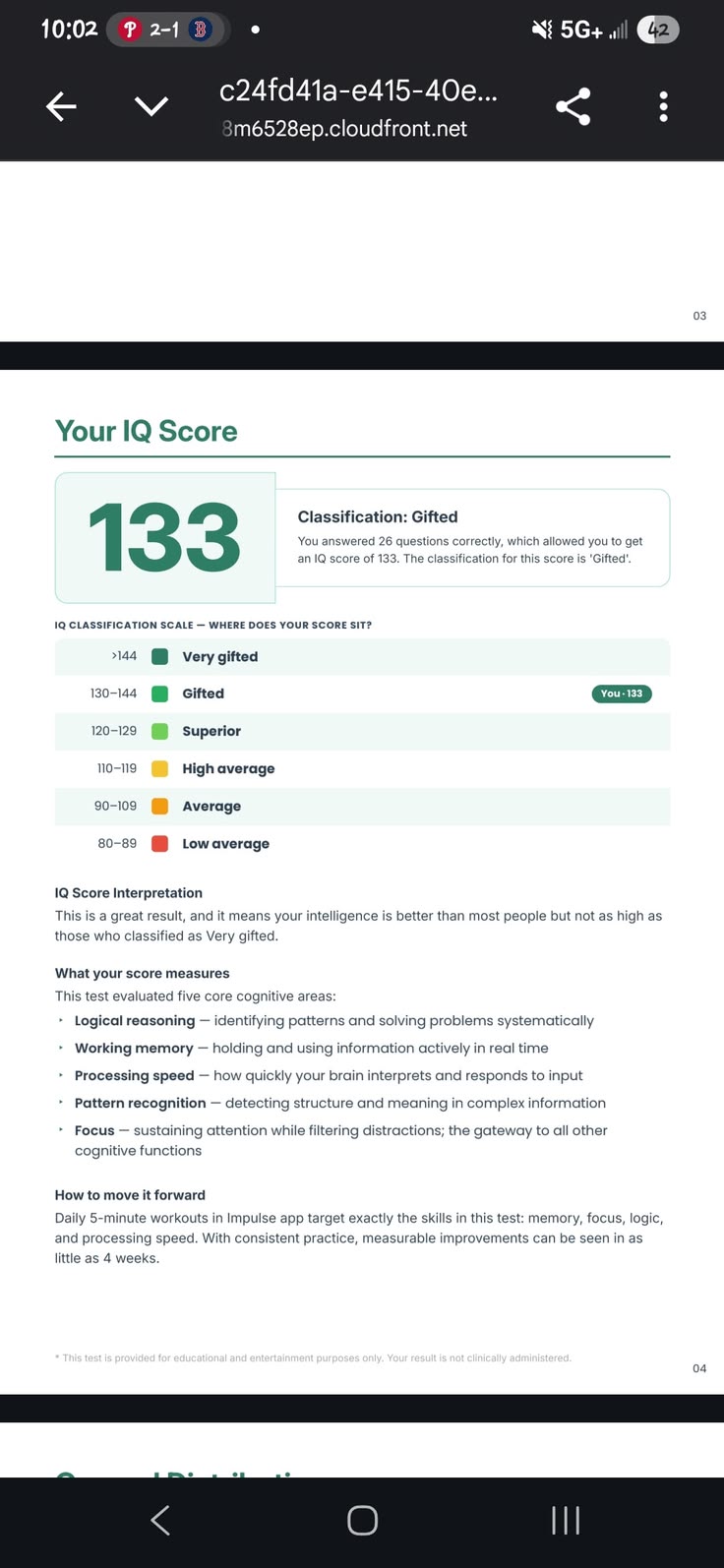
The standard benchmark: on the Wechsler scale (mean = 100, SD = 15), an IQ of 120+ is generally considered "high," 130+ is classified as "gifted" or "very superior," and 145+ enters the range sometimes called "profoundly gifted." These cutoffs are not arbitrary - they correspond to specific percentile thresholds on the normal distribution.
"High intelligence is not a single thing. It is a collection of cognitive strengths that manifest differently in different people and different contexts."
- Linda Gottfredson, University of Delaware
To find out where you stand, you can take our full IQ test for a comprehensive multi-domain assessment.
IQ Classification Systems Compared
Different IQ tests and psychological organizations use slightly different labels for the same score ranges. The table below compares the three most widely used systems.
| IQ Range | Wechsler Classification | Stanford-Binet Classification | Percentile | Rarity (1 in X) |
|---|---|---|---|---|
| 160+ | - | Profoundly Gifted | 99.997th | 1 in 31,560 |
| 145-159 | Very Superior | Highly Advanced | 99.9th | 1 in 741 |
| 130-144 | Very Superior | Gifted/Very Advanced | 98th | 1 in 44 |
| 120-129 | Superior | Superior | 91st | 1 in 11 |
| 110-119 | High Average | High Average | 75th | 1 in 4 |
| 90-109 | Average | Average | 25th-75th | ~1 in 2 |
| 80-89 | Low Average | Low Average | 9th-25th | 1 in 4 |
| Below 70 | Extremely Low | Delayed | Below 2nd | 1 in 44 |
"The label matters less than the pattern. Two people with the same full-scale IQ can have radically different cognitive profiles - and radically different life outcomes."
- Alan Kaufman, IQ test developer and author of IQ Testing 101
What High IQ Actually Predicts: The Data
One of the most extensive datasets on high-IQ outcomes comes from the Study of Mathematically Precocious Youth (SMPY), which has tracked gifted individuals since 1971. Combined with meta-analyses of IQ and life outcomes, the research tells a nuanced story.
Career and Educational Outcomes by IQ Range
| IQ Range | Typical Educational Attainment | Common Career Paths | Median Income Premium (vs. IQ 100) |
|---|---|---|---|
| 100 (baseline) | High school diploma or some college | Skilled trades, clerical, sales | - |
| 110-119 | Bachelor's degree (common) | Teachers, nurses, managers, accountants | +15-20% |
| 120-129 | Bachelor's or master's degree | Engineers, lawyers, senior managers | +25-40% |
| 130-139 | Master's or professional degree (common) | Physicians, scientists, professors, senior executives | +40-60% |
| 140-149 | Doctoral/professional degree (common) | Research scientists, tenured professors, tech founders | +60-100% |
| 150+ | Often doctoral; some drop out of conventional paths | Theoretical researchers, entrepreneurs, polymaths | Highly variable |
What the SMPY Found
The SMPY study (Lubinski & Benbow, 2006) followed over 5,000 individuals identified as intellectually gifted before age 13. By midlife:
- The top 1 in 10,000 (IQ ~160+) were significantly more likely to hold patents, publish academic papers, and earn tenure at top universities than even the top 1 in 100 (IQ ~135)
- Even within the gifted range, higher IQ predicted meaningfully better outcomes - contradicting the popular "threshold theory" that IQ stops mattering above 120
- Non-cognitive factors (interests, personality, opportunity) still accounted for substantial outcome variation
"The idea that IQ does not matter above 120 is a myth. Within the gifted range, each additional standard deviation of ability still predicts important life outcomes."
- David Lubinski, Vanderbilt University
Famous People and Their Reported IQs
While celebrity IQ claims should be treated cautiously (many are estimates, not verified test scores), some well-documented cases illustrate the range of high-IQ profiles.
| Person | Reported IQ | Field | Notable Achievement |
|---|---|---|---|
| Terence Tao | ~225-230 (estimated) | Mathematics | Fields Medal winner; "the Mozart of math" |
| Marilyn vos Savant | 228 (Mega Test; contested) | Writer/columnist | Listed in Guinness Book for highest recorded IQ |
| Christopher Hirata | ~225 (estimated) | Astrophysics | Youngest American to win gold at International Physics Olympiad (age 13) |
| Garry Kasparov | ~190 (estimated) | Chess | Youngest undisputed World Chess Champion |
| Stephen Hawking | ~160 (estimated) | Theoretical physics | Groundbreaking work on black holes and cosmology |
| Albert Einstein | ~160 (estimated, never tested) | Physics | Theory of relativity; Nobel Prize |
| Sharon Stone | ~154 (reported) | Acting | Mensa member; Academy Award nominee |
| Steve Martin | ~142 (reported) | Comedy/writing | Studied philosophy at university; MacArthur-adjacent creative |
| Barack Obama | ~130-145 (estimated) | Politics/law | Harvard Law Review president; 44th U.S. President |
Important Caveats
- Most historical figures (Einstein, da Vinci, etc.) never took standardized IQ tests - their "IQs" are retrospective estimates based on biographical evidence
- Extremely high reported IQs (200+) are controversial because tests become unreliable at the extreme upper end due to insufficient norming data
- IQ is only one dimension of these individuals' success - drive, opportunity, timing, and personality were equally critical
The Practical Advantages of High IQ
Research consistently identifies several concrete advantages associated with high IQ.
Learning Speed and Depth
High-IQ individuals typically:
- Learn new material 2-5 times faster than average on complex tasks (Gottfredson, 1997)
- Require fewer repetitions to master concepts
- Transfer learning from one domain to another more readily
- Handle greater cognitive complexity - more variables, longer chains of reasoning
Professional Performance
Meta-analyses (Schmidt & Hunter, 1998; 2004) established that:
- IQ is the single best predictor of job performance across all job types, with a validity coefficient of approximately 0.50-0.65 for complex jobs
- The predictive power of IQ increases with job complexity
- For the most cognitively demanding roles (research, strategy, engineering), IQ correlates more strongly with performance than any other measurable factor
| Job Complexity Level | IQ Correlation with Performance | Examples |
|---|---|---|
| Low complexity | r = 0.23 | Assembly, routine clerical |
| Medium complexity | r = 0.51 | Skilled trades, sales, nursing |
| High complexity | r = 0.58 | Management, engineering, law |
| Very high complexity | r = 0.65+ | Research science, executive strategy |
Health and Longevity
Surprisingly, IQ is also associated with health outcomes:
- The Scottish Mental Survey (Deary et al., 2004) found that childhood IQ at age 11 predicted mortality risk decades later, with each 15-point IQ increase associated with a 24% reduction in mortality risk
- Proposed mechanisms: higher IQ leads to better health literacy, safer occupational choices, and more effective self-management of chronic conditions
"Intelligence is not just an academic asset. It is a survival tool that helps people navigate the complexity of modern life, from understanding medication labels to evaluating financial risks."
- Ian Deary, University of Edinburgh
The Challenges of High IQ: What Nobody Tells You
High IQ is broadly advantageous, but it comes with genuine challenges that are well-documented in the psychological literature.
Social and Emotional Challenges
| Challenge | Description | Research Evidence |
|---|---|---|
| Asynchronous development | Intellectual maturity outpaces emotional/social development | Common in gifted children (Silverman, 1997); can lead to feeling "out of sync" with peers |
| Existential anxiety | Deeper awareness of mortality, injustice, global problems | Higher rates of existential depression in gifted adolescents (Webb et al., 2005) |
| Perfectionism | Unrealistically high standards for self and others | Strongly associated with giftedness (Speirs Neumeister, 2004) |
| Social isolation | Difficulty finding intellectual peers | The "IQ communication gap" - effective communication breaks down when IQ differs by more than ~30 points (Hollingworth, 1942) |
| Impostor syndrome | Paradoxically common among high achievers | High-IQ individuals may attribute success to luck rather than ability |
The "Multipotentiality" Problem
Gifted individuals often excel at many things, which can paradoxically make career choice harder. When you can succeed at almost anything you try, choosing one path feels like closing doors. This phenomenon, documented extensively by Barbara Kerr and others, can lead to:
- Frequent career changes
- Underachievement relative to potential
- Chronic dissatisfaction despite objective success
"Gifted children often grow into adults who have too many talents, not too few. The challenge is not capability but focus."
- Barbara Kerr, University of Kansas
High IQ Societies: Mensa and Beyond
For those who score in the top percentiles, several organizations exist to provide community and intellectual stimulation.
| Society | IQ Requirement | Percentile | Approximate Members Worldwide |
|---|---|---|---|
| Mensa | 130+ (Wechsler) | Top 2% | ~145,000 |
| Intertel | 135+ | Top 1% | ~1,500 |
| Triple Nine Society | 146+ (Wechsler) | Top 0.1% | ~1,800 |
| Prometheus Society | 160+ (Wechsler) | Top 0.003% | ~100 |
| Mega Society | 176+ (Wechsler) | Top 0.0001% | ~26 |
Membership in these societies is based exclusively on cognitive test scores. Many members report that the primary value is finding intellectual peers - people who share their pace of thinking and breadth of interests.
If you are curious whether you might qualify, our timed IQ test provides a rigorous assessment under standardized conditions. For a lower-pressure start, try our practice IQ test.
High IQ vs. Genius: An Important Distinction
Popular culture often equates "high IQ" with "genius," but psychologists draw an important distinction. Genius is typically defined not by a test score but by transformative creative achievement - producing work that fundamentally changes a field.
| Attribute | High IQ | Genius |
|---|---|---|
| Definition | Score in the top ~2-5% on a standardized test | Transformative creative or intellectual achievement |
| Measurement | IQ test | Historical impact, peer recognition |
| Prevalence | ~1 in 20 to 1 in 50 | Extremely rare (perhaps 1 in millions) |
| Requirements | Strong cognitive ability | Cognitive ability + creativity + drive + opportunity + timing |
| Examples | Most successful professionals | Darwin, Mozart, Marie Curie, Ramanujan |
Many people with IQs above 140 lead productive, successful lives without producing "genius-level" work. Conversely, some widely recognized geniuses had estimated IQs well below 160. The lesson: high IQ is necessary but not sufficient for genius.
"Genius is one percent inspiration and ninety-nine percent perspiration."
- Thomas Edison
How to Accurately Measure Whether Your IQ Is High
If you suspect you have a high IQ and want to confirm it, the approach matters.
Test Quality Hierarchy
| Test Type | Reliability | Best For | Limitations |
|---|---|---|---|
| Professionally administered (WAIS-V, WISC-V, Stanford-Binet 5) | Highest (r = 0.95+) | Clinical/diagnostic use, Mensa qualification | Expensive ($200-500); requires appointment |
| Supervised group tests (Mensa admission test, military ASVAB) | High (r = 0.90+) | Cost-effective screening | Less individualized |
| High-quality online tests (like our full IQ test) | Moderate-high (r = 0.85+) | Accessible self-assessment; practice | No proctor; potential distractions |
| Free internet quizzes | Low-unknown | Entertainment only | Often inflated scores; no norming |
Tips for Getting an Accurate Score
- Take the test when well-rested - fatigue can reduce scores by 5-10 points
- Minimize distractions - find a quiet environment
- Do not practice the specific test you will take for evaluation (this inflates scores without reflecting true ability)
- Consider multiple assessments - any single score has a margin of error of about 3-5 points
- Look at subtest patterns - your profile of strengths (verbal, spatial, processing speed) matters as much as the total score
Start exploring your cognitive profile with our practice IQ test, then progress to the full IQ test for a comprehensive score and percentile ranking.
Conclusion
A high IQ score - generally 120+ for "superior" and 130+ for "gifted" - is a meaningful cognitive advantage associated with faster learning, higher educational attainment, greater career success, and even better health outcomes. But the research is equally clear that high IQ alone does not guarantee any particular outcome. Drive, personality, opportunity, and emotional skills shape what people actually do with their cognitive abilities.
The most productive way to think about a high IQ score is as a tool, not a trophy. It opens doors and accelerates learning, but walking through those doors requires effort, resilience, and purpose.
To discover your own score and percentile, take our full IQ test or start with a quick IQ assessment today.
References
- Lubinski, D., & Benbow, C. P. (2006). Study of Mathematically Precocious Youth after 35 years. Perspectives on Psychological Science, 1(4), 316-345.
- Schmidt, F. L., & Hunter, J. E. (1998). The validity and utility of selection methods in personnel psychology. Psychological Bulletin, 124(2), 262-274.
- Gottfredson, L. S. (1997). Why g matters: The complexity of everyday life. Intelligence, 24(1), 79-132.
- Deary, I. J., Whiteman, M. C., Starr, J. M., Whalley, L. J., & Fox, H. C. (2004). The impact of childhood intelligence on later life. Journal of Personality and Social Psychology, 86(1), 130-147.
- Hollingworth, L. S. (1942). Children Above 180 IQ. World Book Company.
- Silverman, L. K. (1997). The construct of asynchronous development. Peabody Journal of Education, 72(3-4), 36-58.
- Kaufman, A. S. (2009). IQ Testing 101. Springer Publishing.
- Webb, J. T., Meckstroth, E. A., & Tolan, S. S. (2005). Guiding the Gifted Child. Great Potential Press.
- Kerr, B. A. (1997). Smart Girls: A New Psychology of Girls, Women, and Giftedness. Great Potential Press.
- Terman, L. M. (1925-1959). Genetic Studies of Genius (Vols. 1-5). Stanford University Press.
Frequently Asked Questions
Is an IQ of 120 considered gifted?
An IQ of 120 is classified as "Superior" on the Wechsler scale and places you at approximately the 91st percentile, better than about 9 out of 10 people. However, it falls below the standard 130 threshold for "gifted" classification used by most educational programs and high-IQ societies like Mensa.
That said, a score of 120 is impressive by any standard and is associated with above-average academic performance and career outcomes. The SMPY data shows that individuals at IQ 120 still achieve significantly higher educational attainment and income than the population average.
Can my IQ score change over time?
Yes. IQ scores can fluctuate by 5-15 points throughout adulthood due to education, health, cognitive engagement, and life circumstances. Childhood scores are more variable as the brain is still developing: test-retest correlations for children under 6 are only about 0.40-0.60, compared to 0.90+ for adults.
Sustained education appears to raise IQ by approximately 1-5 points per additional year of schooling (Ritchie & Tucker-Drob, 2018). Conversely, chronic stress, untreated depression, and neurodegenerative conditions can lower scores.
How does Mensa verify IQ scores for membership?
Mensa accepts scores from a list of approximately 200 approved standardized tests that place applicants in the top 2% (typically IQ 130+ on the Wechsler scale). Acceptable tests include the WAIS, Stanford-Binet, Cattell Culture Fair, and certain military aptitude tests.
Alternatively, Mensa chapters offer their own supervised testing sessions (usually around $40-60 USD). Scores from unsupervised online tests are not accepted. If you have taken an approved test in the past, you can submit those scores directly.
Are IQ tests culturally biased?
All IQ tests contain some degree of cultural loading, though modern tests work hard to minimize it. Matrix reasoning tests (like Raven's Progressive Matrices) are considered the most "culture-fair" because they use abstract visual patterns rather than language or culturally specific knowledge.
However, even nonverbal tests assume familiarity with certain visual conventions. The key finding from cross-cultural research: IQ tests predict academic and occupational outcomes *within* cultures with reasonable validity, but direct *cross-cultural* score comparisons must be interpreted cautiously.
What is the difference between IQ and emotional intelligence?
IQ measures cognitive abilities: reasoning, memory, processing speed, and problem-solving. Emotional intelligence (EQ), as defined by psychologists Peter Salovey and John Mayer (and popularized by Daniel Goleman), measures the ability to perceive, understand, regulate, and use emotions effectively.
Research shows that IQ and EQ are *modestly correlated* (r = 0.15-0.30) but largely independent. For leadership and interpersonal roles, EQ may be as important as IQ. The most successful individuals tend to have *both* strong cognitive ability and well-developed emotional skills.
Can practice improve my IQ test scores?
Practice with IQ-style questions can improve scores by 3-7 points through reduced test anxiety, increased familiarity with question formats, and better time management. However, this largely reflects *test-taking skill* rather than genuine cognitive improvement.
For meaningful cognitive gains, the evidence favors sustained education, learning new complex skills (such as a musical instrument or a new language), regular physical exercise, and adequate sleep. Our practice IQ test is designed to help you familiarize yourself with the format so your score more accurately reflects your true ability.
Related Articles
Curious about your IQ?
You can take a free online IQ test and get instant results.
Take IQ Test