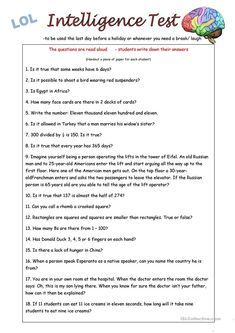
Why Practice Questions Are the Best Way to Prepare for IQ Tests
Understanding your cognitive abilities through IQ testing can be both enlightening and empowering. Research consistently shows that test familiarity is one of the strongest predictors of performance gains on standardized intelligence assessments. A landmark meta-analysis by Hausknecht et al. (2007) found that test-takers who practiced with sample questions improved their scores by an average of 0.26 standard deviations - roughly 3 to 4 IQ points - on their second attempt.
"The best way to improve at any cognitive task is deliberate practice with feedback. IQ tests are no exception." - K. Anders Ericsson, cognitive psychologist and researcher on expertise
In this comprehensive guide, we provide 20+ free IQ practice questions across all major cognitive domains, each with detailed step-by-step solutions. Whether you are encountering IQ tests for the first time or aiming to sharpen your existing skills, these practice problems will build your confidence and refine your problem-solving approach.
What Are IQ Practice Questions and Why Do They Matter?
Free IQ practice questions are sample problems designed to replicate the format and cognitive demands of official intelligence tests such as the Wechsler Adult Intelligence Scale (WAIS-IV), Raven's Progressive Matrices, and the Stanford-Binet Intelligence Scales. They cover a range of cognitive domains including logical reasoning, pattern recognition, verbal comprehension, and spatial abilities.
The Science Behind Practice Effects
The importance of practice lies in what psychologists call the practice effect - measurable score improvements that occur simply from repeated exposure to test formats. A study published in Psychological Bulletin found that practice effects are strongest in the following areas:
| Cognitive Domain | Average Score Gain from Practice | Time to Plateau |
|---|---|---|
| Pattern Recognition | 4-6 IQ points | 3-5 sessions |
| Numerical Reasoning | 3-5 IQ points | 4-6 sessions |
| Verbal Reasoning | 2-4 IQ points | 5-8 sessions |
| Spatial Reasoning | 3-5 IQ points | 3-5 sessions |
| Working Memory | 2-3 IQ points | 6-10 sessions |
"Intelligence is not fixed at birth. Targeted cognitive training can produce reliable improvements in fluid reasoning ability." - Susanne Jaeggi, University of California, Irvine
Moreover, free practice questions serve as a diagnostic tool, helping you identify strengths and weaknesses across different cognitive areas. This targeted awareness allows for focused study and skill development.
For those interested in a structured approach, you can try our practice test to experience a curated selection of questions with detailed explanations.
The Four Core IQ Question Categories
IQ tests typically include questions from four major cognitive domains. Understanding what each category tests helps you focus your preparation effectively.
| Category | What It Measures | Common Question Types | Example Tests That Use It |
|---|---|---|---|
| Verbal Reasoning | Language comprehension, vocabulary, analogies | Word analogies, sentence completion, vocabulary | WAIS-IV, Stanford-Binet |
| Numerical Reasoning | Mathematical logic, number pattern recognition | Number sequences, arithmetic reasoning, data interpretation | Cattell Culture Fair, WAIS-IV |
| Spatial Reasoning | Mental rotation, visual pattern analysis | Shape rotation, matrix completion, paper folding | Raven's Matrices, WAIS-IV Block Design |
| Logical Reasoning | Deductive/inductive logic, rule identification | Syllogisms, if-then statements, pattern completion | Raven's Matrices, Cattell III B |
"The capacity for abstract reasoning - seeing patterns, making inferences, solving novel problems - is the essence of what we call fluid intelligence." - John B. Carroll, psychometrician and author of Human Cognitive Abilities
You can explore all four categories by taking our full IQ test, which includes balanced sections covering these domains.
Pattern Recognition Questions with Solutions
Pattern recognition is considered the purest measure of fluid intelligence - the ability to reason through novel problems without relying on prior knowledge. These questions form the backbone of culture-fair tests like Raven's Progressive Matrices, which has been administered to over 100 million people worldwide.
Question 1: Number Sequence (Easy)
What is the next number in the series? 3, 6, 12, 24, ?
Step-by-step solution:
- Calculate the ratio between consecutive terms: 6/3 = 2, 12/6 = 2, 24/12 = 2
- The pattern is a geometric sequence with a common ratio of 2
- Apply the rule: 24 x 2 = 48
Answer: 48
Why this matters: Geometric sequences appear frequently on IQ tests because they test your ability to identify multiplicative relationships - a core component of mathematical reasoning.
Question 2: Number Sequence (Medium)
What is the next number? 1, 1, 2, 3, 5, 8, 13, ?
Step-by-step solution:
- Examine the differences: 1-1=0, 2-1=1, 3-2=1, 5-3=2, 8-5=3, 13-8=5
- Notice that each number is the sum of the two preceding numbers
- This is the famous Fibonacci sequence: 8 + 13 = 21
Answer: 21
Real-world connection: The Fibonacci sequence appears throughout nature - in sunflower seed spirals, nautilus shells, and galaxy formations. Leonardo Fibonacci introduced this sequence to Western mathematics in 1202.
Question 3: Number Sequence (Hard)
What is the next number? 2, 6, 14, 30, 62, ?
Step-by-step solution:
- Calculate differences: 4, 8, 16, 32 - these are powers of 2
- Alternatively, notice the pattern: each term = (previous term x 2) + 2
- Verify: 2x2+2=6, 6x2+2=14, 14x2+2=30, 30x2+2=62
- Apply: 62 x 2 + 2 = 126
Answer: 126
Why this is challenging: This question requires identifying a compound pattern - both multiplication and addition. High-IQ test questions frequently layer multiple operations to increase difficulty.
Question 4: Visual Pattern (Matrix Reasoning)
In a 3x3 grid, each row contains a circle, square, and triangle. Each row's shapes are filled with white, gray, and black (one each). Row 1: white circle, gray square, black triangle. Row 2: black square, white triangle, gray circle. Row 3: gray triangle, black circle, ?
Step-by-step solution:
- Each shape appears exactly once in each row and column
- Each fill color appears exactly once in each row and column
- Row 3 has gray triangle and black circle; the missing shape is a square
- Row 3 has gray and black used; the remaining color is white
Answer: White square
Strategy tip: For matrix reasoning, always check patterns in both rows and columns. The correct answer must satisfy constraints in both directions simultaneously.
Verbal Reasoning Questions with Solutions
Verbal reasoning measures crystallized intelligence - knowledge and skills accumulated through education and experience. Research by Deary et al. (2007) found that verbal ability measured at age 11 predicted educational achievement and career success more than 40 years later.
Question 5: Verbal Analogy (Easy)
Dog is to Puppy as Cat is to ?
Step-by-step solution:
- Identify the relationship: a puppy is the young offspring of a dog
- Apply the same relationship: the young offspring of a cat is a kitten
Answer: Kitten
Question 6: Verbal Analogy (Medium)
Architect is to Blueprint as Composer is to ?
Step-by-step solution:
- An architect creates a blueprint as their primary planning document
- The relationship is creator to their planning/design output
- A composer creates a score (musical notation) as their primary output
Answer: Score
Why this works: Verbal analogies test your ability to identify relational structures between concepts. The Sternberg Triarchic Theory of Intelligence considers analogical reasoning one of the strongest indicators of analytical intelligence.
Question 7: Verbal Analogy (Hard)
Prolific is to Sparse as Garrulous is to ?
Step-by-step solution:
- Prolific means producing abundantly; sparse means scanty or thin
- The relationship is antonyms (opposite meanings)
- Garrulous means excessively talkative
- The antonym of garrulous is taciturn (reserved, uncommunicative)
Answer: Taciturn
Question 8: Odd One Out
Which word does not belong? Mercury, Venus, Jupiter, Apollo, Saturn
Step-by-step solution:
- Mercury, Venus, Jupiter, and Saturn are all planets in our solar system
- Apollo is a figure from Greek/Roman mythology but is not a planet
- While Mercury, Venus, Jupiter, and Saturn are also mythological figures, the primary grouping is as planets
Answer: Apollo
Test strategy: Odd-one-out questions often include deliberate distractors. Look for the most specific categorization that unifies all but one item.
"Vocabulary knowledge is the single best predictor of general intelligence among all verbal subtests." - David Wechsler, creator of the Wechsler Intelligence Scales
Numerical Reasoning Questions with Solutions
Numerical reasoning tests your ability to work with quantitative information, identify mathematical patterns, and apply logical operations to numbers. On the WAIS-IV, the Arithmetic subtest has a reliability coefficient of 0.88, making it one of the most consistent predictors of general cognitive ability.
Question 9: Arithmetic Reasoning (Easy)
If 5 machines can produce 100 widgets in 4 hours, how many widgets can 8 machines produce in 6 hours?
Step-by-step solution:
- Find the rate per machine per hour: 100 / (5 machines x 4 hours) = 5 widgets per machine per hour
- Calculate total output: 8 machines x 6 hours x 5 widgets = 240 widgets
Answer: 240 widgets
Question 10: Arithmetic Reasoning (Medium)
A train travels from City A to City B at 60 km/h and returns at 40 km/h. What is the average speed for the entire trip?
Step-by-step solution:
- Common mistake: averaging 60 and 40 to get 50 km/h - this is wrong
- For equal distances, use the harmonic mean: 2ab/(a+b)
- Calculate: 2 x 60 x 40 / (60 + 40) = 4800 / 100 = 48 km/h
Answer: 48 km/h (not 50)
Why this trips people up: This question deliberately tests whether you understand that average speed over equal distances requires the harmonic mean, not the arithmetic mean. This is one of the most commonly missed question types on IQ tests.
Question 11: Number Logic (Hard)
If A + B = 12, B + C = 17, and A + C = 13, what are A, B, and C?
Step-by-step solution:
- Add all three equations: 2A + 2B + 2C = 42, so A + B + C = 21
- Subtract each original equation from the total:
- C = 21 - 12 = 9 - A = 21 - 17 = 4 - B = 21 - 13 = 8
- Verify: 4 + 8 = 12, 8 + 9 = 17, 4 + 9 = 13
Answer: A = 4, B = 8, C = 9
Question 12: Data Interpretation
Given the following test scores, which student showed the greatest improvement?
| Student | Test 1 | Test 2 | Test 3 |
|---|---|---|---|
| Alice | 72 | 78 | 85 |
| Bob | 65 | 70 | 73 |
| Carol | 80 | 82 | 83 |
| David | 58 | 68 | 79 |
Step-by-step solution:
- Calculate total improvement (Test 3 - Test 1):
- Alice: 85 - 72 = 13 points - Bob: 73 - 65 = 8 points - Carol: 83 - 80 = 3 points - David: 79 - 58 = 21 points
Answer: David, with a 21-point improvement
Insight: Data interpretation questions test both numerical skill and careful reading - make sure you answer what is actually being asked.
Spatial Reasoning Questions with Solutions
Spatial reasoning measures your ability to mentally manipulate objects in two and three dimensions. Research published in the Journal of Educational Psychology found that spatial ability at age 13 was a stronger predictor of STEM career achievement than either verbal or mathematical ability alone (Wai, Lubinski & Benbow, 2009).
Question 13: Mental Rotation (Easy)
If you rotate the letter "L" clockwise by 90 degrees, what does it look like?
Step-by-step solution:
- The letter L has a vertical line going up and a horizontal line going right at the base
- Rotating 90 degrees clockwise: the vertical line becomes horizontal (pointing right) and the horizontal line becomes vertical (pointing down)
- The result looks like a backwards "L" or the symbol for a right angle rotated
Answer: An upside-down and mirrored L (resembling a rotated right angle)
Question 14: Paper Folding (Medium)
A square piece of paper is folded in half vertically, then a circular hole is punched in the center of the folded paper. How many holes appear when the paper is unfolded?
Step-by-step solution:
- When folded vertically, there are two layers of paper
- Punching one hole goes through both layers
- When unfolded, there are 2 holes, symmetrically placed on either side of the fold line
Answer: 2 holes
Question 15: Cube Folding (Hard)
A cross-shaped net (one center square with four squares attached to each side) is folded into an open box. Which face is the bottom?
Step-by-step solution:
- The center square of the cross becomes the bottom of the box
- The four surrounding squares fold up to become the four sides
- The top remains open since the cross has no square opposite the center
Answer: The center square becomes the bottom
"Spatial ability is the forgotten ability. Despite being one of the strongest predictors of achievement in science, technology, and mathematics, it is rarely assessed or trained in educational settings." - David Lubinski, Vanderbilt University
Logical Reasoning Questions with Solutions
Logical reasoning - the ability to apply rules, draw inferences, and evaluate arguments - is central to what psychometricians call g (general intelligence). These questions test both deductive reasoning (applying general rules to specific cases) and inductive reasoning (identifying general rules from specific examples).
Question 16: Syllogism (Easy)
All roses are flowers. Some flowers fade quickly. Can we conclude that some roses fade quickly?
Step-by-step solution:
- Premise 1: All roses are flowers (A is a subset of B)
- Premise 2: Some flowers fade quickly (some of B have property C)
- The flowers that fade quickly may or may not include roses
- We cannot validly conclude that some roses fade quickly
Answer: No, the conclusion does not follow logically
Why this is important: This is a classic example of the "undistributed middle" fallacy. IQ tests frequently include questions designed to detect whether test-takers apply rigorous logic rather than intuitive but faulty reasoning.
Question 17: Conditional Logic (Medium)
If it rains, the ground is wet. The ground is wet. Can we conclude it rained?
Step-by-step solution:
- The statement says: Rain implies wet ground (if P then Q)
- Wet ground does not imply rain - a sprinkler could cause it
- This is the affirming the consequent fallacy
- We cannot conclude it rained
Answer: No - this is a logical fallacy
Question 18: Pattern Rule (Hard)
Given the sequence of pairs: (2,8), (3,27), (4,64), (5,?)
Step-by-step solution:
- Examine the relationship within each pair: 2^3 = 8, 3^3 = 27, 4^3 = 64
- The pattern is: the second number is the cube of the first
- Therefore: 5^3 = 125
Answer: 125
Comprehensive Difficulty Comparison
Understanding the difficulty levels across question types helps you allocate your preparation time effectively.
| Difficulty Level | Question Types | Average Time to Solve | Percentage of Test-Takers Who Answer Correctly | Strategy |
|---|---|---|---|---|
| Easy | Simple analogies, basic sequences, single-step patterns | 15-30 seconds | 85-95% | Answer quickly, build confidence |
| Medium | Multi-step sequences, compound analogies, paper folding | 30-60 seconds | 55-70% | Spend moderate time, verify answer |
| Hard | Layered patterns, abstract matrices, formal logic | 60-120 seconds | 20-40% | Skip if stuck, return later |
| Very Hard | Multi-variable equations, 3D spatial reasoning | 120+ seconds | 5-15% | Attempt only if time permits |
"The difficulty of a test item is not about complexity alone - it is about the number of mental transformations required to arrive at the correct answer." - Arthur Jensen, University of California, Berkeley
How to Build an Effective Practice Routine
Research from cognitive psychology provides a clear framework for maximizing the benefit of practice questions.
The Optimal Practice Schedule
- Start with a baseline assessment: Take our practice test to identify your starting level and weak areas
- Focus on weak domains first: Spend 60% of practice time on your weakest category, 40% on others
- Use spaced repetition: Practice 3-4 times per week in 20-30 minute sessions rather than one long session
- Review all solutions: Even for questions you answer correctly, study the step-by-step solution to reinforce the reasoning method
- Simulate test conditions: Use our timed IQ test weekly to build speed and pressure management
- Track your progress: Monitor your accuracy rate by category over time
Practice Session Structure
| Phase | Duration | Activity | Purpose |
|---|---|---|---|
| Warm-up | 5 minutes | 3-4 easy questions across categories | Activate cognitive processes |
| Focused practice | 15 minutes | 8-10 questions in your weakest domain | Build targeted skill |
| Mixed practice | 10 minutes | 5-6 questions across all domains | Develop flexibility |
| Review | 10 minutes | Analyze mistakes, study solutions | Deepen understanding |
Common Mistakes to Avoid
- Rushing through easy questions and making careless errors
- Spending too long on a single hard question instead of moving on
- Practicing only your strengths because it feels rewarding
- Skipping the solution review for questions you got right
- Cramming the night before instead of spacing practice over weeks
To track your progress and challenge yourself across all difficulty levels, take our full IQ test or try our quick IQ assessment for a faster evaluation.
The Cognitive Science Behind Practice Effects
Engaging regularly with IQ test questions enhances cognitive functions that extend beyond formal assessments. These include improved working memory, attention to detail, and processing speed.
Research by Jaeggi et al. (2008) published in Proceedings of the National Academy of Sciences demonstrated that working memory training led to significant improvements in fluid intelligence - a finding that generated both excitement and debate in the cognitive science community. While the transferability of training gains remains an active area of research, the evidence for test-specific practice effects is robust and well-established.
"Practice does not make perfect. Only perfect practice makes perfect." - Vince Lombardi (a principle that applies equally to cognitive training)
Neuroimaging studies have shown that repeated practice with cognitive tasks leads to more efficient neural processing - the brain literally requires less energy to perform the same operations after training. This is why experienced test-takers often report that questions feel easier even when objective difficulty remains the same.
Conclusion: From Practice to Mastery
Free IQ practice questions are among the most effective tools available for improving your performance on intelligence assessments. By engaging with diverse question types across all four cognitive domains and studying detailed step-by-step solutions, you build the pattern recognition skills, logical reasoning ability, and test-taking confidence that translate directly to higher scores.
The key principles to remember:
- Variety matters: Practice across all cognitive domains, not just your favorites
- Understand, do not memorize: The goal is to internalize problem-solving methods, not specific answers
- Consistency beats intensity: Regular short sessions outperform occasional marathon study
- Simulate real conditions: Timed practice is essential for building test-day readiness
To get started, take our full IQ test or quick IQ assessment to establish your baseline. For ongoing skill development, our practice test and timed IQ test offer structured opportunities to challenge yourself and track progress.
References
- Hausknecht, J. P., Halpert, J. A., Di Paolo, N. T., & Moriarty Gerrard, M. O. (2007). Retesting in selection: A meta-analysis of coaching and practice effects for tests of cognitive ability. Journal of Applied Psychology, 92(2), 373-385.
- Jaeggi, S. M., Buschkuehl, M., Jonides, J., & Perrig, W. J. (2008). Improving fluid intelligence with training on working memory. Proceedings of the National Academy of Sciences, 105(19), 6829-6833.
- Deary, I. J., Strand, S., Smith, P., & Fernandes, C. (2007). Intelligence and educational achievement. Intelligence, 35(1), 13-21.
- Wai, J., Lubinski, D., & Benbow, C. P. (2009). Spatial ability for STEM domains: Aligning over 50 years of cumulative psychological knowledge solidifies its importance. Journal of Educational Psychology, 101(4), 817-835.
- Carroll, J. B. (1993). Human Cognitive Abilities: A Survey of Factor-Analytic Studies. Cambridge University Press.
- Jensen, A. R. (1998). The g Factor: The Science of Mental Ability. Praeger.
- Sternberg, R. J. (1985). Beyond IQ: A Triarchic Theory of Human Intelligence. Cambridge University Press.
- Lohman, D. F. (1996). Spatial ability and g. In I. Dennis & P. Tapsfield (Eds.), Human Abilities: Their Nature and Measurement (pp. 97-116). Lawrence Erlbaum Associates.
Frequently Asked Questions
How often should I practice free IQ test questions to see improvement?
Research on the spacing effect (Cepeda et al., 2006) shows that practicing 3-4 times per week in sessions of 20-30 minutes produces better results than one long weekly session. Most test-takers see measurable improvement within 2-3 weeks of consistent practice, with gains of 3-5 IQ points on average. The key is *spaced repetition* - reviewing both new and previously encountered question types - which strengthens long-term retention and transfer of problem-solving skills.
Can practicing IQ test questions improve my actual IQ score?
Yes, but with important nuances. A meta-analysis by Hausknecht et al. (2007) found that practice produces an average improvement of 0.26 standard deviations (about 3-4 IQ points) on retesting. The gains come primarily from three sources: (1) reduced test anxiety, (2) familiarity with question formats, and (3) improved problem-solving strategies.
However, these gains tend to plateau after 5-7 practice sessions. Practice improves your ability to *demonstrate* your intelligence effectively, which is itself a meaningful and practical outcome.
Are free IQ practice questions reliable indicators of my true intelligence?
Free practice questions are best understood as *training tools* rather than precise measurement instruments. Official IQ tests like the WAIS-IV undergo rigorous standardization with normative samples of thousands of participants and have reliability coefficients above 0.90.
Free practice questions lack this standardization but remain valuable for building familiarity with question types, identifying cognitive strengths and weaknesses, and developing test-taking strategies. For a more accurate assessment, take our full IQ test.
What should I do if I find certain IQ question types particularly difficult?
Targeted practice is the most effective approach. Research on deliberate practice (Ericsson, 1993) shows that focusing on your weakest areas produces the largest gains. Start by identifying your weakest domain using our practice test, then dedicate 60% of your practice time to that area.
Break difficult problems into component steps, study the solutions even when you get answers wrong, and gradually increase difficulty. Most test-takers find that their weakest area shows the *most rapid improvement* with targeted practice.
Is it better to take timed or untimed IQ practice tests?
Both serve distinct purposes and should be used strategically. Begin with untimed practice to build accuracy and deep understanding of problem-solving methods - this is your foundation. Once you consistently achieve 80%+ accuracy, switch to timed practice to build speed and pressure management. Research on test anxiety (Hembree, 1988) shows that simulating timed conditions during preparation reduces anxiety by up to 40% on test day.
Our timed IQ test and practice test support both approaches.
Can free IQ practice questions be used for cognitive training beyond test preparation?
Absolutely. A growing body of research supports using structured cognitive exercises for *lifelong mental fitness*. Practicing pattern recognition strengthens analytical thinking useful in data science and strategic planning. Verbal reasoning exercises improve reading comprehension and communication. Spatial reasoning training has been shown to improve performance in STEM fields (Uttal et al., 2013).
While the transfer of training gains to real-world tasks is still debated in cognitive science, the evidence for domain-specific improvements is strong and well-documented.
Related Articles

Curious about your IQ?
You can take a free online IQ test and get instant results.
Take IQ Test