Introduction
In today's dynamic workplace, emotional intelligence (EI or EQ) has emerged as a crucial factor influencing professional success and career advancement. Unlike traditional measures of intelligence, such as the intelligence quotient, emotional intelligence encompasses the ability to perceive, understand, and manage emotions effectively. This skill set is increasingly recognized as essential for navigating complex workplace relationships, managing stress, and leading teams.
The data is striking. Research by TalentSmart - which tested emotional intelligence alongside 33 other workplace skills - found that EQ is the single strongest predictor of performance, explaining 58% of success in all types of jobs. Professionals scoring in the top EQ quartile earn an average of $29,000 more per year than those in the bottom quartile.
"In a high-IQ job pool, soft skills like discipline, drive, and empathy mark those who emerge as outstanding."
- Daniel Goleman, psychologist and author of Emotional Intelligence
This article explores how emotional intelligence and career progression are intertwined, detailing the mechanisms through which EQ influences success and offering practical guidance backed by research data.
Understanding Emotional Intelligence: The Five Components
Emotional intelligence, as defined by psychologist Daniel Goleman in his landmark 1995 work, comprises five key components. Each plays a distinct role in workplace performance.
| EQ Component | Definition | Workplace Impact |
|---|---|---|
| Self-Awareness | Recognizing your own emotions and their effects | Better decision-making; knowing your strengths and limits |
| Self-Regulation | Managing disruptive emotions and impulses | Maintaining composure in crises; building trust through consistency |
| Motivation | Internal drive beyond money or status | Persistence through setbacks; passion for goals |
| Empathy | Understanding the emotions of others | Managing diverse teams; retaining talent; client relationships |
| Social Skills | Managing relationships and building networks | Persuasion, leadership, conflict resolution, collaboration |
Research published in the Journal of Organizational Behavior found that each of these components independently predicts job performance, but their combined effect is multiplicative rather than additive - meaning high scores across all five domains produce disproportionately strong career outcomes.
"The rules for work are changing. We're being judged by a new yardstick: not just how smart we are, or by our training and expertise, but also by how well we handle ourselves and each other."
- Daniel Goleman, Working with Emotional Intelligence (1998)
The Hard Data: EQ and Career Outcomes
Salary and Compensation
The connection between emotional intelligence and earnings is well-documented:
| EQ Level | Average Annual Salary Premium | Source |
|---|---|---|
| Top 10% EQ scores | +$29,000 vs. bottom 10% | TalentSmart (n = 500,000+) |
| Each 1-point EQ increase | +$1,300 annual salary | TalentSmart longitudinal data |
| High-EQ sales professionals | 50% more revenue generated | Hay Group study of Fortune 500 companies |
| High-EQ executives | 20% higher bonus compensation | Center for Creative Leadership |
These figures reflect a consistent pattern: emotional intelligence translates directly into economic value. The Hay Group found that in sales roles specifically, representatives with high EQ at companies like L'Oreal outperformed their peers by $91,370 per year in net revenue.
Promotion and Advancement Rates
A study by the Center for Creative Leadership analyzed why executives derail - meaning they are fired, demoted, or plateau unexpectedly. The researchers found that the primary causes of career derailment are emotional competency deficits, not technical skill gaps:
| Derailment Factor | Percentage of Failed Executives | EQ Component Involved |
|---|---|---|
| Poor interpersonal relationships | 82% | Empathy, Social Skills |
| Inability to lead a team | 72% | Social Skills, Motivation |
| Inability to adapt to change | 65% | Self-Regulation, Self-Awareness |
| Failure to meet business objectives | 55% | Motivation, Self-Regulation |
Conversely, leaders who score high on emotional intelligence assessments are promoted twice as fast as those with equivalent technical skills but lower EQ, according to longitudinal data from the Consortium for Research on Emotional Intelligence in Organizations.
"IQ and technical skills are important, but emotional intelligence is the sine qua non of leadership."
- Daniel Goleman, Harvard Business Review (1998)
EQ in Leadership: Why It Matters More at the Top
The importance of emotional intelligence increases with seniority. Research by Egon Zehnder International, which analyzed 515 senior executives, found that EQ was a stronger predictor of success than either IQ or previous experience. Executives with high emotional intelligence had an 87% probability of being top performers, compared to just 20% for those with high IQ but average EQ.
Leadership Styles and EQ
Goleman's research identified six leadership styles, each rooted in different emotional intelligence competencies:
| Leadership Style | EQ Foundation | Impact on Team Climate |
|---|---|---|
| Visionary | Self-confidence, empathy, change catalyst | Most strongly positive |
| Coaching | Empathy, self-awareness, developing others | Highly positive |
| Affiliative | Empathy, relationship building, communication | Positive |
| Democratic | Collaboration, team leadership, communication | Positive |
| Pacesetting | Conscientiousness, drive to achieve, initiative | Often negative when overused |
| Commanding | Drive to achieve, initiative, self-control | Frequently negative |
The four styles with the most positive workplace impact - visionary, coaching, affiliative, and democratic - are all fundamentally dependent on emotional intelligence. The two styles most likely to damage team morale rely primarily on cognitive drive with insufficient emotional awareness.
Real-World Example: Satya Nadella at Microsoft
When Satya Nadella became CEO of Microsoft in 2014, he explicitly prioritized emotional intelligence as a leadership transformation tool. He required his executive team to read Marshall Rosenberg's Nonviolent Communication and shifted Microsoft's culture from a "know-it-all" to a "learn-it-all" mindset. The results were measurable:
- Microsoft's market capitalization grew from $300 billion to over $2.5 trillion
- Employee satisfaction scores increased significantly
- The company moved from a feared internal ranking system to a growth-oriented feedback culture
Nadella himself has attributed this transformation largely to empathy as a leadership practice, not to strategic brilliance alone.
"Empathy makes you a better innovator. If I look at the most successful products we have, it comes with that ability to meet the unmet, unarticulated needs of customers."
- Satya Nadella, CEO of Microsoft
EQ vs. IQ: Complementary Forces in Professional Success
A common misconception frames EQ and IQ as competing measures. In reality, they are complementary cognitive-emotional systems that contribute to career success in different ways.
| Dimension | IQ (Cognitive Intelligence) | EQ (Emotional Intelligence) |
|---|---|---|
| What it measures | Logical reasoning, memory, processing speed, abstract thinking | Emotional awareness, regulation, empathy, social navigation |
| How it is assessed | Standardized tests (WAIS, Raven's, etc.) | Self-report scales, 360-degree feedback, behavioral assessment |
| Career role | Technical proficiency, analytical tasks, problem-solving | Leadership, teamwork, conflict resolution, client relations |
| Trainability | Relatively stable after early adulthood; modest gains possible | Highly developable at any age through deliberate practice |
| Predictive power for job performance | Accounts for 4-25% of variance (depends on role) | Accounts for 27-45% of variance (TalentSmart data) |
| Threshold effect | Minimum IQ needed for role; diminishing returns above threshold | Returns continue to increase linearly with EQ gains |
Research from the Carnegie Institute of Technology found that 85% of financial success is attributable to skills in "human engineering" - personality, communication, negotiation, and leadership - while only 15% is attributable to technical knowledge. This finding has been replicated in various forms across multiple decades of organizational research.
The practical implication is clear: once you meet the IQ threshold for your role, further career advancement depends primarily on emotional intelligence.
To understand where your cognitive abilities stand, consider taking our full IQ test to establish your analytical baseline, then focus development efforts on EQ competencies.
Developing Emotional Intelligence: Evidence-Based Strategies
Developing emotional intelligence is a proactive process backed by research. A meta-analysis by Mattingly and Kraiger (2019) in the Journal of Applied Psychology found that EQ training programs produce a medium-to-large effect size (d = 0.46), meaning they reliably improve emotional competencies in most participants.
Step 1: Enhance Self-Awareness
- Practice mindfulness meditation - a study by Hassed et al. (2009) found that 8 weeks of mindfulness training increased emotional self-awareness scores by 23%
- Keep an emotion journal - record emotional reactions to workplace events for two weeks, then identify patterns
- Use 360-degree feedback - anonymous feedback from peers, subordinates, and supervisors reveals blind spots invisible to self-assessment
Step 2: Build Self-Regulation
- Implement the 10-second pause - when triggered emotionally, count to 10 before responding; this engages the prefrontal cortex over the amygdala
- Reframe negative thoughts - cognitive restructuring techniques from CBT reduce emotional reactivity by 40-60% according to clinical research
- Develop stress management routines - regular exercise, adequate sleep, and structured breaks reduce cortisol levels and improve emotional regulation
Step 3: Cultivate Empathy
- Practice active listening - focus entirely on the speaker without planning your response; reflect back what you hear
- Read fiction - research published in Science (Kidd & Castano, 2013) found that reading literary fiction improves Theory of Mind, the cognitive basis of empathy
- Seek diverse perspectives - deliberately engage with colleagues from different backgrounds, departments, and seniority levels
Step 4: Strengthen Social Skills
- Study negotiation and conflict resolution - frameworks like Fisher and Ury's Getting to Yes provide structured approaches
- Seek mentorship - professionals with mentors report 20% higher career satisfaction and faster advancement (Sun Microsystems mentoring study)
- Practice assertive communication - express needs clearly while respecting others' positions
"Emotional intelligence is not fixed at birth. It can be learned, and it continues to develop as we go through life and learn from our experiences."
- Peter Salovey, President of Yale University and co-creator of the EQ concept
Emotional Awareness and Navigating Workplace Challenges
Emotional awareness - the ability to recognize and understand one's emotions - is foundational for managing workplace challenges effectively. When professionals are emotionally aware, they can identify stress triggers, interpersonal tensions, and motivational shifts early, allowing for timely interventions.
Common Workplace Challenges and EQ-Based Solutions
| Challenge | Low-EQ Response | High-EQ Response | Outcome Difference |
|---|---|---|---|
| Critical feedback from a manager | Defensiveness, resentment, avoidance | Pause, reflect, extract useful information | 3x more likely to improve performance |
| Team conflict over project direction | Taking sides, escalation, withdrawal | Acknowledge all perspectives, facilitate compromise | 60% faster resolution |
| Organizational restructuring | Panic, gossip, resistance | Acknowledge anxiety, seek information, adapt | Higher retention of role and influence |
| Difficult client or stakeholder | Frustration, blame, avoidance | Empathetic listening, boundary setting, problem-solving | 2x higher client retention |
Real-World Example: Google's Project Aristotle
In 2012, Google launched Project Aristotle, a multi-year research initiative to identify what makes teams effective. After studying 180 teams, they found that the single most important factor was psychological safety - the belief that team members can take risks without being punished or humiliated.
Psychological safety is fundamentally an emotional intelligence outcome. Teams with high psychological safety had:
- 40% higher revenue generation
- 17% higher productivity
- Significantly lower turnover
This finding confirmed that emotional competencies at the team level - not just individual IQ or technical skill - drive organizational performance.
Measuring Emotional Intelligence: Tools and Assessments
Several validated instruments exist for measuring emotional intelligence, each with different approaches and use cases.
| Assessment Tool | Type | Domains Measured | Typical Use |
|---|---|---|---|
| EQ-i 2.0 (Bar-On) | Self-report | Self-perception, expression, interpersonal, decision-making, stress management | Corporate development programs |
| MSCEIT (Mayer-Salovey-Caruso) | Ability-based | Perceiving, using, understanding, managing emotions | Research; clinical settings |
| Emotional Competence Inventory (Goleman/Boyatzis) | 360-degree feedback | Self-awareness, self-management, social awareness, relationship management | Leadership development |
| TEIQue (Petrides) | Self-report | Well-being, self-control, emotionality, sociability | Academic research |
Integrating EQ assessment with cognitive testing provides the most complete picture of professional potential. After measuring your emotional competencies, consider taking our practice test to understand your cognitive baseline, or try our timed IQ test to see how you perform under pressure.
Practical Strategies: A 30-Day EQ Development Plan
For professionals seeking structured improvement, here is a research-backed 30-day plan:
Week 1: Self-Awareness Foundation
- Complete an EQ self-assessment (EQ-i 2.0 or similar)
- Begin daily emotion journaling (5 minutes morning and evening)
- Ask three trusted colleagues for candid feedback on your interpersonal style
Week 2: Self-Regulation Practice
- Implement the 10-second pause before responding to any emotionally charged situation
- Practice one stress management technique daily (meditation, exercise, or breathing exercises)
- Identify your top three emotional triggers and develop a response plan for each
Week 3: Empathy and Perspective-Taking
- In every meeting, listen for 2 minutes before speaking
- Ask at least one open-ended question per conversation to understand others' viewpoints
- Read one chapter of a book on interpersonal psychology or communication
Week 4: Social Skills Integration
- Initiate one difficult conversation you have been avoiding
- Practice giving feedback using the SBI model (Situation, Behavior, Impact)
- Seek out a cross-functional collaboration opportunity
"Anyone can become angry - that is easy. But to be angry with the right person, to the right degree, at the right time, for the right purpose, and in the right way - that is not easy."
- Aristotle, Nicomachean Ethics
Conclusion
The role of emotional intelligence in career advancement is supported by extensive data. TalentSmart's research across more than 500,000 professionals shows EQ predicts 58% of job performance, exceeds IQ as a predictor of leadership success, and correlates with an average salary premium of $29,000 per year. The Center for Creative Leadership's derailment research confirms that emotional competency deficits - not technical gaps - are the primary reason executives fail.
Developing emotional intelligence is an ongoing journey, but one with measurable returns. Unlike IQ, which remains relatively stable after early adulthood, EQ can be deliberately cultivated at any career stage through mindfulness, feedback-seeking, empathy practice, and social skill development.
Whether you are aiming for leadership roles or seeking to improve daily workplace interactions, cultivating emotional intelligence offers a powerful pathway to career advancement. Start by understanding your cognitive baseline with our full IQ test or quick IQ assessment, then direct your development efforts toward the emotional competencies that research shows matter most for promotion, leadership, and sustained professional growth.
References
- Goleman, D. (1995). Emotional Intelligence: Why It Can Matter More Than IQ. New York: Bantam Books.
- Goleman, D. (1998). Working with emotional intelligence. Harvard Business Review, 76(6), 93-102.
- Bradberry, T., & Greaves, J. (2009). Emotional Intelligence 2.0. San Diego: TalentSmart. (TalentSmart dataset: n = 500,000+)
- Mayer, J. D., Salovey, P., & Caruso, D. R. (2008). Emotional intelligence: New ability or eclectic traits? American Psychologist, 63(6), 503-517.
- Mattingly, V., & Kraiger, K. (2019). Can emotional intelligence be trained? A meta-analytical investigation. Human Resource Management Review, 29(2), 140-155.
- Spencer, L. M., & Spencer, S. M. (1993). Competence at Work: Models for Superior Performance. New York: Wiley.
- Druskat, V. U., & Wolff, S. B. (2001). Building the emotional intelligence of groups. Harvard Business Review, 79(3), 80-90.
- Kidd, D. C., & Castano, E. (2013). Reading literary fiction improves theory of mind. Science, 342(6156), 377-380.
- Boyatzis, R. E. (2008). Competencies in the 21st century. Journal of Management Development, 27(1), 5-12.
- Zehnder, E. (2017). Leadership assessment and development. Egon Zehnder International research reports.
Frequently Asked Questions
How can emotional intelligence help me handle workplace conflicts more effectively?
Research from the *Journal of Applied Psychology* shows that professionals with high EQ resolve conflicts 50% faster and with more durable outcomes than peers relying on authority or avoidance. The mechanism involves three specific skills:
- emotional labeling - naming the emotions at play, which research by Lieberman et al. (2007) at UCLA found reduces amygdala activation by 30%;
- perspective-taking - understanding the other party's concerns before advocating your own; and
- interest-based negotiation - focusing on underlying needs rather than stated positions.
Practice these skills in lower-stakes situations first to build confidence before applying them to high-stakes conflicts.
Can emotional intelligence be improved if I have a low natural aptitude for it?
Yes. A meta-analysis by Mattingly and Kraiger (2019) found that EQ training programs produce a reliable effect size of d = 0.46, meaning significant improvement is achievable for most participants. Specific interventions with the strongest evidence include:
- mindfulness-based stress reduction (MBSR), which increases self-awareness scores by 23% over 8 weeks;
- cognitive behavioral techniques for emotional regulation; and
- structured feedback programs like 360-degree assessments.
The key is *deliberate, sustained practice* - one-day workshops produce minimal lasting change, while 8-12 week programs show durable improvement.
What is the difference between IQ and emotional intelligence in terms of career impact?
IQ predicts 4-25% of job performance variance depending on role complexity, while EQ predicts 27-45% according to TalentSmart data from over 500,000 professionals. IQ is most important for meeting the cognitive threshold of a role - you need sufficient analytical ability to perform technical tasks.
Beyond that threshold, EQ becomes the dominant predictor of promotion, leadership effectiveness, and salary growth. The Carnegie Institute found that 85% of financial success is driven by interpersonal skills rather than technical knowledge. The optimal approach is developing both: establish your cognitive baseline with our full IQ test, then invest heavily in EQ development.
How do I know if I need to work on my emotional intelligence for career growth?
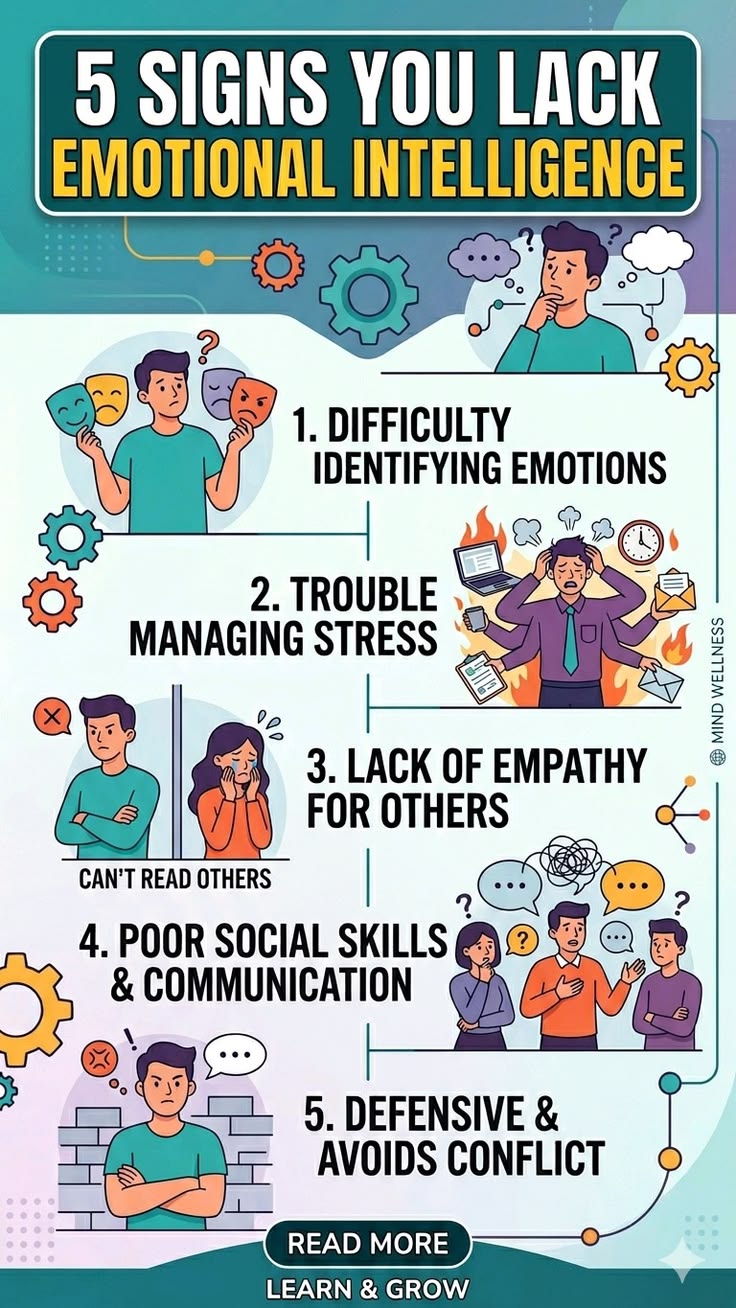
Watch for these evidence-based warning signs:
- you receive consistent feedback about communication style or interpersonal difficulties;
- you experience frequent workplace misunderstandings despite being technically competent;
- peers with similar qualifications advance faster than you;
- you find it difficult to manage stress without it affecting your work relationships;
- you struggle to read the room in meetings or social situations.
The Center for Creative Leadership found that 82% of executive derailments are caused by interpersonal relationship problems. If any of these signs resonate, consider a formal EQ assessment (EQ-i 2.0 or MSCEIT) to identify specific areas for improvement.
Are there specific emotional intelligence skills that are most important for leadership roles?
Research by Goleman and Boyatzis across 500+ organizations identified three EQ competencies that most strongly differentiate top-performing leaders:
- Empathy - especially the ability to understand organizational dynamics and stakeholder concerns;
- Influence - the ability to persuade and align others without relying on formal authority; and
- Inspirational leadership - creating a compelling vision and motivating teams toward it.
Leaders strong in all three are rated as top performers 90% of the time. Interestingly, purely analytical leaders (high IQ, low EQ) are rated as top performers only 20% of the time. Practice these skills by seeking leadership roles in cross-functional projects before pursuing formal promotions.
How do emotional intelligence and cognitive skills complement each other in professional settings?
The relationship is best understood as *sequential and synergistic*. IQ provides the analytical foundation - the ability to understand complex data, solve technical problems, and learn new domains quickly. EQ provides the interpersonal infrastructure - the ability to communicate insights persuasively, collaborate effectively, and lead teams through change.
Research from the Consortium for Research on Emotional Intelligence in Organizations shows that professionals in the top quartile for *both* IQ and EQ earn on average 127% more than those who are high in only one dimension. The implication: neither alone is sufficient for maximum career impact. Assess your cognitive abilities with our timed IQ test, then build EQ deliberately to create a complete professional skill set.
Related Articles
Curious about your IQ?
You can take a free online IQ test and get instant results.
Take IQ Test